

Background
The Oath of the Peach Garden appears at the opening of Romance of the Three Kingdoms. Its historical setting is anchored to the first year of Zhongping, when Zhang Jue raised his banner in revolt and Liu Yan, governor of You Province, posted notices calling for recruits. The novel first introduces Liu Bei in a partly mythologized biography: a descendant of the Prince Jing of Zhongshan, he has a large mulberry tree in his family courtyard whose canopy resembles a carriage roof, and a physiognomist predicts that “a noble person will surely emerge” from the family. It also emphasizes that he “has long been ambitious and especially enjoys befriending heroes throughout the realm,” establishing the character traits that make the ensuing oath plausible.
Zhang Fei and Guan Yu then enter the narrative, and the three meet on the streets of Zhuo County, finding themselves kindred spirits. In the novel’s narrative structure, the Oath of the Peach Garden is not merely a private pact among three men; it is also the opening ritual that sets the ethical axis of the entire book: “the relationship between ruler and subject is made equivalent to the bonds of brotherhood.”
The Oath
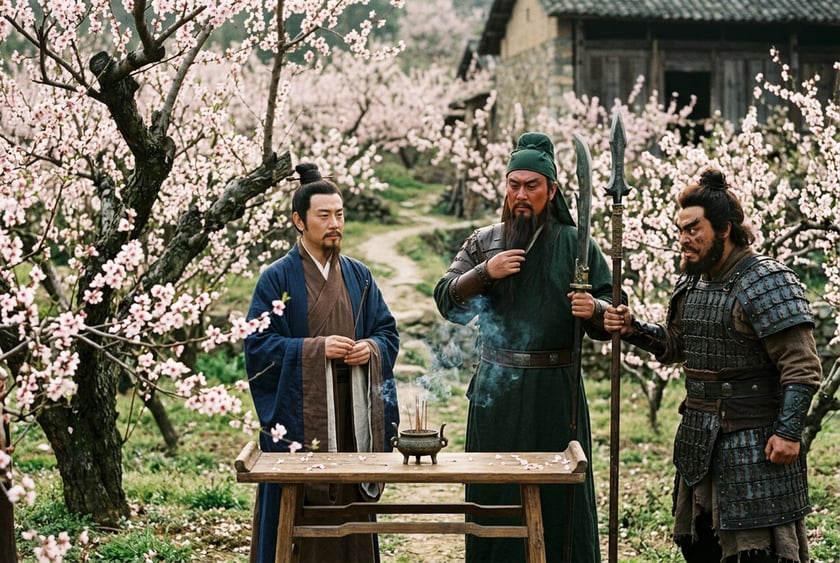
The central ritual in the peach garden has two steps: first, Zhang Fei proposes that they make offerings to Heaven and Earth in the garden behind his manor; then the three burn incense, bow again, and swear their oath. The oath contains several key phrases. “Though we bear different surnames, we have now become brothers” asserts that a bond modeled on blood kinship can transcend the limits of different surnames. “With one heart and united strength, we will rescue the distressed and aid those in peril” elevates a private pact into a responsibility toward all the people under Heaven. “Above, we will serve the state; below, we will bring peace to the common people” casts their purpose as loyalty to the Han dynasty’s order, rather than founding a new regime. “We do not seek to be born in the same year, month, and day; we only wish to die in the same year, month, and day” makes solidarity in life and death part of the oath itself.
Combining ethical, political, and life-and-death commitments in a single oath is not unusual in traditional brotherhood pacts. But placing it at the forefront of a Three Kingdoms story means that, from the very beginning, all the events that follow—from protecting a sister-in-law over a thousand li to Guan Yu Attends the Meeting Armed with a Single Blade, Liu Bei's Deathbed Entrustment at Baidi, and the campaign of vengeance against Wu—are drawn into a moral cycle in which “to break the oath is to deserve death.” After the oath, Guan Yu has an eighty-two-jin Green Dragon Crescent Blade made, Zhang Fei a spear with an eighteen-span shaft and a steel point, and Liu Bei a pair of double-edged swords. Two merchants from Zhongshan also provide horses and metal supplies, rapidly carrying the ritual into the stage of material preparations.
Later Influence
This fictional event served for centuries as the main gateway to the Shu Han narrative in Romance of the Three Kingdoms and in the dramas, storytelling performances, New Year prints, and folk beliefs that followed. It gave rise to at least three lines of influence. First, it recast the ruler-subject relationship as one of brotherhood. When later readers assessed Liu Bei’s campaign against Wu, their most common measure was not national strategy, but the idea that “when the second brother is dead, the eldest brother cannot simply leave his death unavenged”—a way of judging made possible by the Peach Garden oath. Second, Guan Yu and Zhang Fei were repeatedly deified in Yuan and Ming variety plays and local operas of the Qing dynasty. The Oath of the Peach Garden became the origin story of the faith in loyalty and righteousness, and the practice of placing all three figures side by side in statues at Guan Di temples grew out of this tradition. Third, from the perspective of political philosophy, the oath binds “serving the Han” to “saving the people,” allowing the Shu Han regime to retain moral legitimacy in public opinion for a thousand years. Even though official histories grant Cao Wei greater political legitimacy, the Peach Garden continued to provide Shu Han with popular support.
In literary terms, the novel crystallizes the ethical tone, cast of characters, and central plot of the entire book in less than a page of its first chapter. This technique of compression and resonance is precisely what enabled Romance of the Three Kingdoms to maintain its hold over ethical storytelling for centuries.