Emperor Ling of Han
also called 汉灵帝 · 156–189
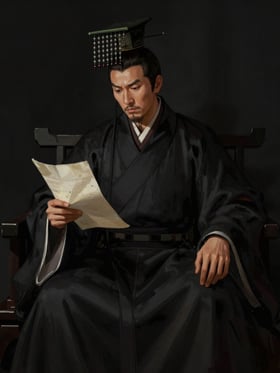
Records say Liu Hong rebuked the Three Ducal Offices after Cao Cao’s remonstrance; the novel shows Emperor Ling favoring the Ten Attendants.
Life
In the novel: 4 chapters · In the Records: 1 volume
Life156–189
Appearances
By chapter (5)
Novel
- 1
- 2
- 22
- 38
Records
- 1
On the boards
Compare with someone →Where this person ranks on each board.
Historical Record
Volume 1 of the Records of the Three Kingdoms places Liu Hong against the backdrop of political disorder in the late Eastern Han. The general-in-chief Dou Wu and Grand Tutor Chen Fan once plotted to execute the eunuchs, but were killed instead. After Liu Hong ascended the throne, Cao Cao submitted a memorial stating that Dou Wu and Chen Fan had been upright men who were framed. He pointed out that the court was rife with treacherous men and that good men were being obstructed, but Liu Hong did not heed his advice. Later, an imperial edict ordered the Three Excellencies to recommend and report on officials whose performance in the commanderies and counties was ineffective and who had become the subject of popular rhymes. The historical account criticizes the Three Excellencies for catering to the times and avoiding powerful relatives: they failed to report the crimes of the strong, while those who upheld principle were falsely accused. After an omen, Cao Cao submitted another urgent remonstrance, accusing the Three Excellencies of favoring powerful relatives in their recommendations. Liu Hong was moved by this; he showed the memorial to the Three Excellencies and reprimanded them. Those summoned because of the rhymes were later appointed Gentlemen of Discussion. Thereafter, government and instruction grew ever more disorderly, and the powerful and lawless grew ever more numerous. Cao Cao believed that matters could no longer be put right and stopped offering advice. As portrayed in the historical account, Liu Hong did respond to urgent remonstrances, but he was also caught in a situation where powerful nobles dominated, the court was failing, and its course was difficult to reverse.
In the Novel
Romance of the Three Kingdoms portrays Emperor Ling as a ruler who presided over eunuch domination and the decay of the court. The novel opens by invoking the political crisis under Emperors Huan and Ling to explain that disorder was about to engulf the realm: Dou Wu and Chen Fan failed in their plot to execute the eunuchs, whose power consequently grew stronger. A green serpent descended in Wende Hall, followed by a succession of omens, including earthquakes, tidal waves, and hens turning into roosters. Cai Yong submitted a memorial condemning the interference of women and eunuchs in government, but Empress Cao Jie had him framed. The novel also depicts Emperor Ling honoring Zhang Rang as “Father” and allowing Zhang Rang and the other Ten Attendants to control the court, bringing popular resentment and banditry in their wake.
During the Yellow Turban Rebellion, the novel says that Emperor Ling ordered He Jin to send troops to capture and execute Ma Yuanyi, and instructed local authorities to prepare defenses and dispatched generals to suppress Zhang Jue. Yet the court’s reliance on and favor toward the eunuchs remained unchanged. Later, Zhang Jun blamed the Yellow Turban Rebellion on the Ten Attendants’ sale of offices and abuse of the people, but the Ten Attendants denounced him as “deceiving the ruler.” Liu Tao, while attending a banquet in the rear garden, openly laid out the dangers of the crisis. Emperor Ling listened to his attendants and ordered Liu Tao dealt with; Chen Dan then came to remonstrate and was imprisoned and killed along with Liu Tao. The novel relates that when Emperor Ling was gravely ill, Jian Shuo proposed killing He Jin first so that Prince Xie could be enthroned. After Emperor Ling died, He Jin and Yuan Shao and others enthroned Crown Prince Bian. These specific dialogues, plots, and court scenes belong to the novel’s narrative; the Records of the Three Kingdoms does not provide the same details. Through them, the novel depicts Emperor Ling as a ruler who relied on eunuchs, could not heed loyal advice, and faced a succession crisis.
Key Relationships
- The eunuch faction: Romance of the Three Kingdoms portrays Zhang Rang, Zhao Zhong, and the other Ten Attendants as the center of power around Emperor Ling. It depicts Emperor Ling honoring Zhang Rang as “Father” and being influenced by their faction. The Records of the Three Kingdoms, by contrast, records that Emperor Ling did not heed Cao Cao’s urgent remonstrance about the court being rife with treacherous men, and does not mention the novel’s “Father” episode.
- Cao Cao: The historical account records that Cao Cao submitted memorials concerning the deaths of Dou Wu and Chen Fan and the Three Excellencies’ avoidance of powerful relatives. Emperor Ling reprimanded the Three Excellencies after Cao Cao’s urgent remonstrance prompted by an omen. The novel depicts Cao Cao advising He Jin, when Emperor Ling was gravely ill, to settle the succession first and then deal with the eunuchs; this on-the-spot counsel is unique to the novel.
- He Jin and the succession: The novel says that when Emperor Ling was gravely ill, Jian Shuo sought to use the enthronement of Prince Xie as an opportunity to eliminate He Jin. After Emperor Ling’s death, Crown Prince Bian succeeded to the throne. This set of court arrangements and dialogues is unique to the novel.
- Liu Tao and Chen Dan: The novel has the two men remonstrate in turn against the eunuchs’ domination. Both are imprisoned by Emperor Ling and later killed. This is not recorded in the provided Records of the Three Kingdoms and is unique to the novel.
Signature Scenes
- Omen and urgent remonstrance: In the novel, a green serpent descends in Wende Hall, followed by various other omens. Cai Yong submits a memorial declaring that women and eunuchs are interfering in government. Emperor Ling sighs after reading it, but cannot prevent Empress Cao Jie from framing Cai Yong. This dramatic court scene is unique to the novel. The historical account separately records that Cao Cao submitted a memorial prompted by an omen, and that Emperor Ling showed it to the Three Excellencies and reprimanded them. The speakers and events in these two accounts should not be conflated.
- Banquet in the rear garden and Liu Tao’s remonstrance: The novel depicts Emperor Ling drinking with the Ten Attendants when Liu Tao weeps as he remonstrates face-to-face, warning that bandits are rising throughout the land and that disaster is near. Emperor Ling instead orders him executed for “slandering close ministers,” and Chen Dan is later imprisoned for remonstrating as well. This scene is unique to the novel and presents its depiction of Emperor Ling as benighted and unwilling to heed advice.
- Grave illness and succession turmoil: When Emperor Ling falls seriously ill, he summons He Jin to the palace, where Jian Shuo proposes eliminating He Jin first. After Emperor Ling dies, He Jin, Yuan Shao, and others enthrone Crown Prince Bian. The novel uses this tense transfer of power at court to conclude its account of Emperor Ling’s reign, linking it to eunuch power and the succession.
Lines
- 演 ch.2 §11→ Liu Tao
「國家承平,有何危急?」
- 演 ch.2 §12→ Chen Dan
「毀謗近臣,冒朕躬。」
- Family
- Lord & vassal
- Enemies
- Other
Who is Emperor Ling of Han connected to?
Pick someone to see how many steps lie between them and Emperor Ling of Han.
Combat
On the field
Duels, kills and executions as the texts tell them, counted separately for the Records and the Romance.
- RomanceCh. 1ExecutionorderedMa Yuanyi「帝召大將軍何進調兵擒馬元義,斬之」
Events
Events (3)
Battles and events the texts place this person in, by date.
Other events
Places
- Native of
- Hejian StateRecords
Continue
Empress Dowager He
Spouse