Cao Wei · Chancellor's Clerk for Military Strategy
Xu Miao
courtesy name 景山 · 172–249
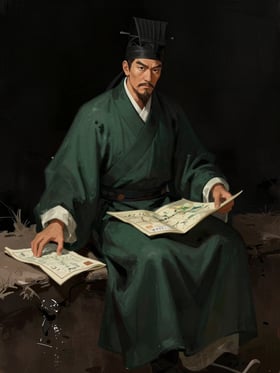
Xu Miao, a celebrated Cao Wei official, was known for governing Liang Province, his integrity, and his drunken reply, “a sage within.”
Life
In the Records: 3 volumes
Life172–249
Appearances
- Cao Wei· Undated
On the boards
Compare with someone →Where this person ranks on each board.
Historical Record
Xu Miao, courtesy name Jingshan, was from Ji County in the state of Yan. After Cao Cao Pacifies Hebei, he summoned Xu Miao to serve as a military adviser in the Chancellor’s staff. Xu Miao later held posts including Magistrate of Fenggao and Clerk of the Eastern Bureau of Deliberations; after the establishment of the Wei kingdom, he became a Gentleman of the Secretariat. During a ban on alcohol in Wei, Xu Miao drank in private until he was drunk. When the Inspector Zhao Da questioned him about Cao Cao, Xu Miao replied that he was “in the presence of a sage.” Zhao Da reported this, and Cao Cao was furious. Xianyu Fu explained that “sage” meant clear wine and “worthy” meant cloudy wine, and Xu Miao was thereby spared punishment. Later, at Xu Chang, Emperor Wen asked whether Xu Miao was still “in the presence of a sage.” Xu Miao replied by citing Zifan and Yushu, who had brought trouble upon themselves through drinking, and added that he was known to people because he got drunk. Emperor Wen laughed and remarked that Xu Miao’s reputation was well deserved.
Xu Miao successively served as Administrator of Longxi and Nanan. During Emperor Wen’s reign, he also held the posts of Chancellor of Qiao, Administrator of Pingyang and Anping, and Commandant of Agriculture in Yingchuan. He earned a good reputation and achieved notable results at every post. Emperor Ming appointed him Inspector of Liang Province, with acting authority as Colonel-Director of the Qiang. At the time, Zhuge Liang had advanced from Mount Qi, and three commanderies in Longyou had rebelled. Xu Miao sent a general to defeat the rebels of Nanan. He later improved the salt ponds of Wuwei and Jiuquan, greatly expanded irrigated fields, and recruited the poor to cultivate them, making households prosperous and granaries full. He also established schools, clarified educational directives, reformed local customs, and won merit by putting down the rebellious Qiang leader Ke Wu. He promoted contact with the Western Regions and the presentation of tribute from the frontier. In dealing with the Qiang and Hu peoples, he did not pursue minor offenses; for serious crimes, he first informed the tribal commanders and then dealt with the offenders according to law. He distributed rewards among his soldiers and kept none for household use.
In the first year of the Zhengshi era, Xu Miao returned to court as Grand Minister of Agriculture and was promoted to Colonel-Director of Sili; later, he became Grandee Secretary. In the ninth year of Zhengshi, he was appointed Minister over the Masses. Believing that the Three Excellencies were charged with discussing the Way and that the office should remain vacant rather than be filled by an unsuitable candidate, he firmly declined the appointment. In the first year of the Jiaping era, Xu Miao died at home at the age of seventy-eight and was posthumously titled Marquis Mu. The court, remembering that he, Hu Zhi, and Tian Yu had served loyally and impartially without seeking personal wealth, granted his family two thousand hu of grain and three hundred thousand cash. Lu Qin praised Xu Miao for his lofty aspirations, pure conduct, broad talents, and vigorous spirit, while noting that he could be lofty without being aloof and forceful yet magnanimous. Lu Qin also pointed to Xu Miao’s constancy throughout his life as proof that popular judgments shift with the times, whereas Xu Miao himself maintained enduring principles.
In the Novel
This person does not appear in the novel. No novel material is available, so there are no fictional episodes to compare with his historical biography. Xu Miao’s career, his administration of Liang Province, the anecdote about being “in the presence of a sage,” and his refusal of the post of Minister over the Masses are all recounted on the basis of the Records of the Three Kingdoms and should not be rewritten as portrayals from the novel.
Key Relationships
Xu Miao served Cao Wei and held office under Cao Cao, Cao Pi, Cao Rui, and the courts that followed. Cao Cao was once angered by Xu Miao’s drunken remark during the ban on alcohol, but Xianyu Fu defused the situation by explaining the elegant terms for wine. Emperor Wen later asked Xu Miao about the “in the presence of a sage” incident in person. Xu Miao answered with composure, leaving behind a witty yet measured exchange between ruler and subject. In Liang Province, as Inspector and Colonel-Director of the Qiang, Xu Miao coordinated frontier defense, agriculture, and education, and dealt with the Qiang and Hu peoples with a balance of leniency and severity. When the court later honored him, it also named him alongside Hu Zhi and Tian Yu as a loyal and incorruptible official who put public duty before private interest.
Lu Qin’s assessment of Xu Miao particularly emphasized his “constancy”: people in Cao Cao’s time regarded him as open-minded, but when later fashions grew extravagant, Xu Miao continued to live simply and was consequently regarded as stern and uncompromising. Relevant records also note that Han Guan was Xu Miao’s fellow townsman and rival in reputation; details of their association are not known.
Defining Scenes
Drunk, he answers, “In the presence of a sage.” During the ban on alcohol, Xu Miao, drunk, answered Zhao Da with the words “in the presence of a sage.” Xianyu Fu explained the coded terms for clear and cloudy wine, freeing him from blame. Emperor Wen later brought up the incident again. Xu Miao did not hide his fondness for wine and joked about himself by citing the story of an ancient figure punished for drinking. The exchange showed both his quick wit and his tact.
Securing the frontier through agricultural policy in Liang Province. Faced with little rain and food shortages, Xu Miao repaired the salt ponds, opened irrigated fields, and recruited the poor to farm, making households prosperous and stores full. At the same time, he promoted education and instruction, reformed local customs, and handled Qiang and Hu affairs by overlooking minor offenses while severely punishing major crimes. From agricultural livelihoods to order on the frontier, these measures formed the core of his achievements in Liang Province.
Declining the post of Minister over the Masses and keeping to his principles. Xu Miao was appointed Minister over the Masses, but believed that the Three Excellencies’ duty of discussing the Way should not be reduced to an empty title. He would rather leave the post vacant than occupy it while old and ill, and ultimately refused the appointment firmly. After his death in old age, the court honored his integrity by granting rewards to his family.
Quotes
3 lines in the books · 3 featured
「中聖人。」
This allusion spread far and wide, becoming a classic expression for describing drunkenness.
「昔子反斃於穀陽,御叔罰於飲酒,臣嗜同二子,不能自懲,時復中之。然宿瘤以醜見傳,而臣以醉見識。」
Xu Miao invokes the past to comment on the present, cleverly defending himself and revealing his singular character and wit.
「三公論道之官,無其人則缺,豈可以老病忝之哉?」
It reflects his clear-eyed self-awareness and his sense of responsibility toward the state.
- Friends
- Other
Who is Xu Miao connected to?
Pick someone to see how many steps lie between them and Xu Miao.
Places
- Native of
- JiRecords
- Was at
- YingchuanRecords
- Governed
- Liang ProvinceRecords
- Longxi CommanderyRecords
- Nan'anRecords
Continue
Xianyu Fu
Friend
Relationship timeline2 entries ▸
History · vol. 27
Fights
Governor of Liang Province; when Zhuge Liang advanced on Mount Qi, three commanderies in Longyou rebelled; sent an army staff officer and the Administrator of Jincheng to attack the rebels of Nanan and defeated them
- Han Guan§6
Friend
from the same commandery and equally renowned; Guan ranked ahead of Sun Li and Lu Yu
Inner monologues · AI-generated1 monologue ▸
- I am Xu Miao, courtesy name Jingshan, from Ji in Yan Commandery. Looking back on my life, I have often reflected that th