Ten Attendants
Duan Gui
–189
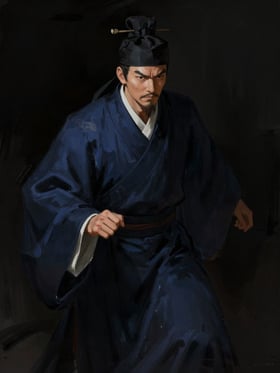
Duan Gui, a Han court eunuch, abducted the young emperor and fled, then drowned; the novel says Min Gong pursued and killed him.

Life
In the novel: 3 chapters · In the Records: 1 volume
Life?–189
189 CE (Zhongping 6)
- Assassination of He JinLuoyangInstigator
Allegiance
Appearances
By chapter (4)
Novel
- 1
- 2
- 3
Records
- 6
- Ten Attendants
- Hatched: dated by chapter
- Life event
- Death
On the boards
Compare with someone →Where this person ranks on each board.
Historical Record
Duan Gui was a Regular Attendant in the Eastern Han court. After Emperor Ling died, He Jin and Yuan Shao plotted to exterminate the eunuchs, but the empress dowager refused. He Jin summoned Dong Zhuo to lead troops into the capital, and when word spread, the situation in the palace grew tense at once. Duan Gui and the others falsely claimed to be acting on the empress dowager’s orders and summoned He Jin into the palace to discuss affairs, then killed him. After He Jin’s death, Yuan Shao and the others hunted down and killed eunuchs in the palace, while Duan Gui and his associates seized the young emperor and the Prince of Chenliu and fled to Xiaoping Ford. With pursuers closing in, Duan Gui and the others threw themselves into the river and died, while the young emperor was able to return to the palace. The Records of the Three Kingdoms recounts Duan Gui’s part in the palace abduction and flight but gives no details about his personal motives or his final moments.
By the time Dong Zhuo entered the capital in response to He Jin’s summons, He Jin had already been killed. Duan Gui and the others abducted the emperor and took him to Xiaoping Ford, where Dong Zhuo led his men to meet the young emperor at Be Mang and escort him back to the palace. The historical record thus depicts the chaos of eunuchs holding the emperor hostage while outside troops came to receive him, and connects Duan Gui’s actions with Dong Zhuo’s seizure of military power in the capital. However, the surviving accounts do not say that Duan Gui and Dong Zhuo had a personal alliance.
In the Novel
Romance of the Three Kingdoms portrays Duan Gui as one of the Ten Attendants, acting alongside Zhang Rang. The novel says that Zhang Rang and Duan Gui used gold and pearls to win over He Miao and Lady Wuyang, enabling the Ten Attendants to regain Empress Dowager He’s favor. This political maneuvering sets the stage for the later rupture between He Jin and the eunuchs. It is a dramatized portrayal of palace relations in the novel; the material in the Records of the Three Kingdoms contains no such bribery episode.
The novel depicts the Assassination of He Jin as a carefully laid ambush at the palace gate: Zhang Rang and the others hide armed men, use an imperial edict from the empress dowager to lure He Jin into the palace, and have Duan Gui and Zhang Rang meet him at the gate of Jiade Hall. The hidden troops then hack He Jin to death. The outcome broadly matches the historical account that they “falsely claimed the empress dowager’s orders, summoned He Jin to a meeting, and then killed him,” but the novel adds the ambush, dialogue, and specific manner of killing, which should not be treated as historical fact.
After He Jin is killed, the novel says that Duan Gui and Zhang Rang abduct Empress Dowager He, the young emperor, and the Prince of Chenliu. Lu Zhi calls on Duan Gui to stop abducting the empress dowager, and Duan Gui turns and flees. He later joins Zhang Rang in taking the two princes toward Be Mang. When the pursuers catch up, Zhang Rang throws himself into the river, while Min Gong catches and kills Duan Gui, hanging his head from his horse’s neck. The historical account likewise says that Duan Gui and the others abducted the emperor, fled to Xiaoping Ford, and died by throwing themselves into the river. The novel, however, changes Duan Gui’s fate to his being hunted down and killed, and adds episodes in which he becomes separated from the two princes during the flight and Min Gong searches for the emperor.
Key Relationships
- Zhang Rang: In the novel, Duan Gui’s important accomplice. The two plot together, arrange for He Jin to be drawn into their scheme, and abduct the emperor and flee after the eunuchs’ defeat. The Records of the Three Kingdoms also lists Duan Gui alongside Zhang Rang and the others as one of those who abducted the emperor, but gives no details of their personal relationship.
- He Jin: A key opponent in the political conflict surrounding Duan Gui. The historical account says that Duan Gui and the others falsely claimed to have an imperial edict summoning He Jin to the palace, where they killed him. The novel, by contrast, depicts Zhang Rang and Duan Gui laying an ambush to lure He Jin to his death.
- The young emperor and the Prince of Chenliu: The historical account says that Duan Gui and the others abducted the young emperor and fled, and that Dong Zhuo later escorted the emperor back to the palace. The novel adds the two princes’ flight by night, their separation from their captors, and their rescue.
- Min Gong: In the novel, he pursues and kills Duan Gui. Although the surviving Records of the Three Kingdoms says that Duan Gui and the others died by throwing themselves into the river, it does not record Min Gong killing Duan Gui or hanging his head. (Unique to the novel.)
Signature Scenes
Falsely claiming an edict to summon He Jin into the palace: The historical account briefly records that Duan Gui and the others falsely claimed to be acting on the empress dowager’s orders and summoned He Jin into the palace for a discussion, where he was killed. This is Duan Gui’s clearest political action in the historical record, and shows how palace commands were used as tools in a coup.
Fleeing with the emperor: The historical account says that Duan Gui and the others took the young emperor toward Xiaoping Ford, and that Dong Zhuo later met the emperor at Be Mang and escorted him back to the palace. The novel expands the flight into a dramatic sequence: they pass through a burning area at night, hurry toward Be Mang, and the two princes hide in weeds by the riverbank and use fireflies to find their way. These details are part of the novel’s dramatic scene and should not be conflated with the historical account.
Min Gong hanging Duan Gui’s head: The novel concludes Duan Gui’s personal story with Min Gong catching and killing him, then hanging his head from his horse’s neck—a different ending from the historical account’s statement that they “all threw themselves into the river and died.” This specific pursuit and beheading scene is unique to the novel.
- Friends
- Enemies
Who is Duan Gui connected to?
Pick someone to see how many steps lie between them and Duan Gui.
Combat
On the field
Duels, kills and executions as the texts tell them, counted separately for the Records and the Romance.
- RecordsJuan 6AssassinationHe JinWon「召進入議,遂殺之」
- RomanceCh. 3AssassinationHe JinWon「伏甲齊出,將何進砍為兩段」
- RomanceCh. 3ExecutionMin GongLost「貢遂殺段圭,懸頭於馬項下」
Stratagems
Plans this person devised or saw through, as the texts tell them.
- Records
- 1 carried out · 1 worked · 0 turned down · 0 seen through
- Romance
- 1 carried out · 1 worked · 0 turned down · 0 seen through
- RecordsForged Edict to Kill He JinDeceptionWorkedJuan 6「中常侍段珪等矯太后命,召進入議,遂殺之」
- RomanceUse Bribes to Sow DiscordSowing discordWorkedagainst He JinCh. 2「遂皆以金珠玩好結搆何進弟何曲並其母舞陽君」
Events
Events (3)
Battles and events the texts place this person in, by date.
Other events
- 184Yellow Turban Rebellion
- 189Assassination of He JinInstigator
- 189Dong Zhuo's Coup
Continue
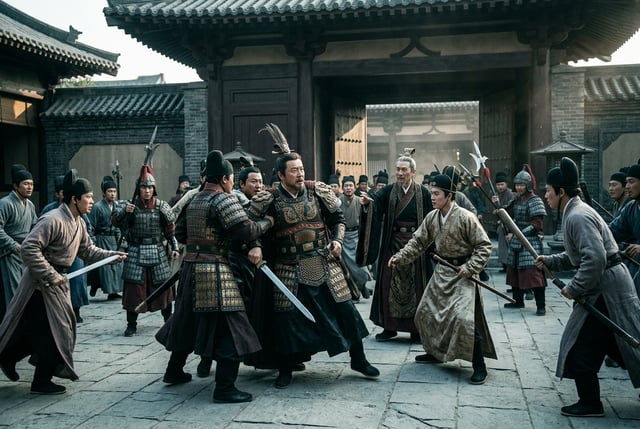
Assassination of He Jin
Relationship timeline3 entries ▸
Inner monologues · AI-generated1 monologue ▸
- As Duan Gui, I lived within the palace precincts. Day after day, all I saw were palace gates, imperial edicts, and the c