Cao Wei · Attendant of the Palace Cavalry
Liu Shao
courtesy name 孔才 · c. 170–c. 245
Not to be confused with Liu Shao (刘邵) — Liu Shao, a general of Eastern Wu, lured Cao Xiu to Wan with Shi Yi during the Huangwu era, where Cao Xiu was soundly defeated.
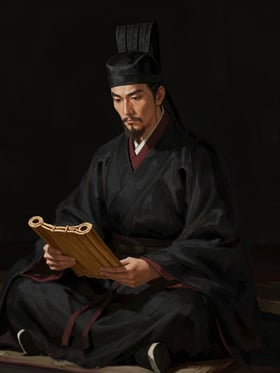
Cao Wei official Liu Shao helped draft the New Laws and evaluation rules, advised at Hefei, and is sent to relieve Jiangxia in the novel.
Life
In the novel: 1 chapter · In the Records: 3 volumes
Life170–245
Appearances
By chapter (4)
Novel
- 103
Records
- 21
- 22
- 24
- Cao Wei· Undated
On the boards
Compare with someone →Where this person ranks on each board.
Historical Record
Liu Shao, courtesy name Kongcai, was from Handan, Guangping. During the Jian’an era, he went to Xu as a planning clerk. On one occasion, the Grand Astrologer predicted a solar eclipse on the first day of the year, and the court officials debated whether to suspend court or cancel the audience. Citing ritual norms, Liu Shao argued that sages did not abolish court rites in advance over celestial anomalies that had not yet occurred; the phenomenon might fade, or the calculations might be mistaken. Xun Yu agreed with him, and the court audience went ahead as usual. There was no eclipse that day. This episode shows that Liu Shao was well versed in the classics and ritual norms, and could offer considered judgments in discussions of government affairs.
Liu Shao was once summoned to serve by the Imperial Secretary Xi Lü. After Xi Lü was dismissed, Liu Shao first served as a Household Gentleman to the Heir Apparent, then was promoted to Secretary. During the Huangchu era, he held the posts of Gentleman of the Secretariat and Palace Attendant-in-Ordinary. By imperial command, he brought together the Five Classics and other books, organized and classified them, and helped compile the Huanglan. After Emperor Ming took the throne, Liu Shao became Administrator of Chenliu, where he was known for promoting education and was praised by the people. He was later summoned and appointed Cavalry Commandant, and, together with Yu Yi, Xun Shen, and others, deliberated on regulations and statutes, drafting the eighteen chapters of the New Statutes. He also wrote the Discussion of the Statutes in Brief, and was subsequently promoted to Palace Attendant-in-Ordinary.
When Sun Quan granted Gongsun Yuan the title “King of Yan,” some at court argued that his envoys should be detained and troops sent to punish him. Liu Shao pointed out that Gongsun Yuan Zhi Fu had once beheaded and sent back the brothers Yuan Shang, and that the truth of the current reports was still uncertain. He urged leniency, giving Gongsun Yuan the chance to reform. Later, Gongsun Yuan indeed killed Sun Quan’s envoys Zhang Mi and the others, and sent back their heads. During the Qinglong era, when Wu forces besieged Hefei, Liu Shao again advised first sending infantry and elite cavalry to raise a show of force and create the appearance of a larger army, while threatening the Wu forces’ line of retreat and supply route. Emperor Ming adopted the plan; before the reinforcements arrived, the Wu army had already withdrawn.
During the Jingchu era, Liu Shao was ordered to formulate the seventy-two articles of the Performance Assessment of the Metropolitan Officials and wrote the Discussion in Brief, seeking to establish a system for evaluating officials. He also advocated establishing ritual and music to change customs, and wrote fourteen chapters of the Treatise on Music. However, he had not yet submitted it before Emperor Ming died, and it was never put into practice. His proposals on performance assessment were discussed and questioned by Fu Gu, Cui Lin, and others. Fu Gu believed the foundations of the system were not yet in place, and that proceeding with assessments first would make it difficult to distinguish the worthy from the incompetent. Cui Lin, by contrast, stressed that the value of a system lay in maintaining it. During the Zhengshi era, Liu Shao lectured on the classics and was granted the title of Marquis within the Passes. He wrote more than a hundred works, including the Fa Lun and Treatise on People, and was posthumously awarded the title of Grand Master of Splendid Happiness.
In the Novel
Chapter 103 of Romance of the Three Kingdoms portrays Liu Shao as a Cao Wei general. When Sun Quan sent forces to attack along three routes, Cao Rui also divided his forces to respond, ordering Liu Shao to lead troops to relieve Jiangxia, Tian Yu to relieve Xiangyang, and himself to lead troops with Man Chong to relieve Hefei. Through this deployment, the novel places Liu Shao on the front lines of the Wei-Wu conflict, presenting him as a general tasked with holding a separate sector and taking part in the defense.
However, the relevant events in this chapter focus mainly on Cao Rui’s division of his forces; they do not describe in detail what Liu Shao did after reaching Jiangxia, the course of any fighting, or his personal strategy. Compared with the historical portrayal of Liu Shao as a figure known for debate, compiling statutes, and policy proposals, the novel here emphasizes his identity as a Wei general and his relief mission. The stratagem he proposed at Hefei in the historical record—sending out troops to display force and disrupt the enemy’s retreat—was put forward when Wu forces were besieging the city and should not be conflated with the novel’s deployment of relief forces along three routes.
Key Relationships
Liu Shao’s relationship with Xun Yu is reflected in the debate over the predicted solar eclipse on the first day of the year: Xun Yu endorsed Liu Shao’s judgment, based on ritual norms, against suspending court in advance. Later, Liu Shao worked with Yu Yi and Xun Shen to deliberate on regulations and statutes and draft the New Statutes, reflecting his collaborative role in the development of Cao Wei law.
In debates over court policy, Liu Shao advocated leniency toward Gongsun Yuan, arguing against sending troops on the basis of unverified reports alone. When Hefei was besieged, he proposed a specific show of force to Emperor Ming; after the emperor adopted it, the Wu army withdrew. Once his performance assessment plan came before the court, Fu Gu and Cui Lin offered differing opinions, showing that the system for evaluating officials was not without controversy.
The novel’s account of Liu Shao being ordered to relieve Jiangxia is a military deployment presented in the fiction; the Records of the Three Kingdoms provided here does not record this relief mission. (Unique to the novel)
Signature Scenes
One scene that best illustrates Liu Shao’s style in deliberation comes when a solar eclipse is predicted for the first day of the year. Rather than hastily suspending court because of the forecast, he cites ritual norms and the possibility of an error in the calculations to argue that the court audience should proceed as usual. As it happened, there was no eclipse that day.
Another scene takes place when Wu forces have besieged Hefei. Liu Shao does not recommend rushing into battle against an enemy at the height of its momentum. Instead, he proposes first sending out infantry and cavalry, displaying banners and beating drums to make a show of force, and threatening the enemy’s route home and supply lines. Emperor Ming follows his plan, and the Wu army withdraws before the reinforcements arrive. This is a representative episode in the historical record of Liu Shao using strategy to take part in military decision-making.
The novel’s signature moment, by contrast, comes when Cao Rui divides his forces to counter Sun Quan and orders Liu Shao to lead troops to relieve Jiangxia. It places the historical figure within a three-pronged defensive deployment, but the available material from the novel gives no further account of his performance on the battlefield. (Unique to the novel)
Family, lords and rivals
1 relationships
Who is Liu Shao connected to?
Pick someone to see how many steps lie between them and Liu Shao.
Combat
On the field
Duels, kills and executions as the texts tell them, counted separately for the Records and the Romance.
Stratagems
Plans this person devised or saw through, as the texts tell them.
- Records
- 1 carried out · 1 worked · 0 turned down · 0 seen through
- RecordsFeigned TroopsFeintWorkedagainst WuJuan 21「兵比至合肥,賊果退還」
Events
Events (1)
Battles and events the texts place this person in, by date.
Other events
Places
- Governed
- ChenliuRecords
Continue
Xiahou Hui
Friend
Inner monologues · AI-generated1 monologue ▸
- Whenever I reflect on the course of my official career, I see that advancement and decline in rank do not always depend