Cao Wei · Minister of Works
Zhao Yan
courtesy name 伯然 · 171–245
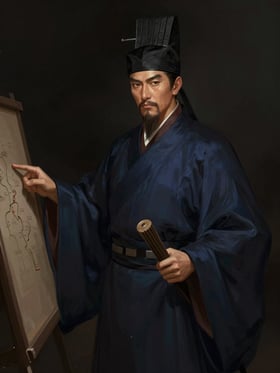
Zhao Yan was a famed Cao Wei minister from Yingchuan, known for calming troops, coordinating generals, and counsel at Fancheng.
Life
In the Records: 4 volumes
Life171–245
Appearances
- Cao Wei· Undated
On the boards
Compare with someone →Where this person ranks on each board.
Historical Record
Zhao Yan, courtesy name Boran, was from Yangdi in Yingchuan. While taking refuge from unrest in Jing Province at the end of the Han, he shared resources and plans with Du Xi and Fan Qin, and they lived together as one household. When he heard that Cao Cao had brought Emperor Xian of Han to Xu, he judged that Cao Cao could restore and aid the realm. In the second year of Jian’an, at the age of twenty-seven, Zhao Yan led the old and weak to join Cao Cao and was appointed magistrate of Langling. He punished powerful and unscrupulous men in the county and dealt with criminals according to the law. Later, when Yuan Shao invaded south and many commanderies and counties in Yu Province responded, Zhao Yan urged Li Tong, Commandant of Yang’an, to delay collecting the household levy. He also petitioned Xun Yu to return the silk to the people. After Cao Cao approved, the commandery was pacified. Zhao Yan had also once dealt with Li Tong’s wife’s uncle according to the law. Li Tong praised him for enforcing the law impartially, and the two became close friends.
Zhao Yan later entered the central administration as a registrar in the Office of the Minister over the Masses. He helped coordinate relations among the stationed forces, fostering good relations between commanders such as Yu Jin, Yue Jin, and Zhang Liao. He subsequently served as Director of the Commanders’ Supervisors, commanding seven armies, and later held posts including Administrator of Fufeng and Protector of the Army in Guanzhong. When soldiers in Guanzhong mutinied on the march, he went in person to their camp to calm the troops, examined the matter and punished the ringleaders while pardoning the rest, and found a way to secure the soldiers’ surrender and relocation. The historical record states that “in all, more than twenty thousand people were saved and brought through.” Pei Songzhi’s annotation also cites Sun Sheng’s criticism of the methods Zhao Yan used to win their trust, showing that although his actions spared many lives, they were not entirely without controversy.
When Guan Yu besieged Cao Ren at Fancheng, Zhao Yan served as a military adviser. He proposed that they avoid a hasty assault and instead communicate with Cao Ren inside the city by means of tunnels and written messages shot by arrow, waiting for reinforcements to arrive before attacking from within and without. After Guan Yu withdrew, Zhao Yan also urged Cao Ren not to pursue him, arguing that Guan Yu should be left in place to restrain Sun Quan. An order later sent by Cao Cao accorded with this judgment. After Cao Wei was founded, Zhao Yan successively held posts including Palace Attendant, Administrator of Hedong, military adviser, Director of the尚书 office, and Commander of Yong and Liang Provinces. In the fourth year of Zhengshi, he requested leave to return to the capital on account of his age and illness. He later became General of Agile Cavalry and Minister over the Masses. In the sixth year of Zhengshi, he was promoted to Minister over the Masses; he died in June of that year, received the posthumous title Marquis Mu, and was succeeded by his son Zhao Ting. He was renowned alongside Xin Pi, Chen Qun, and Du Xi, and people of the time called them “Xin, Chen, Du, and Zhao.”
In the Novel
The materials provided contain no portrayal of Zhao Yan in novels such as Romance of the Three Kingdoms; the novel does not mention him. These materials therefore provide no basis for adding fictional words, deeds, military accomplishments, or dramatic encounters to his story. The accounts above of his joining Cao Cao, mediating military and political affairs, and taking part in the military council at Fancheng are all drawn from historical biographies recorded in the Records of the Three Kingdoms and Pei Songzhi’s annotations.
Key Relationships
While taking refuge from unrest in Jing Province, Zhao Yan lived with Du Xi and Fan Qin, sharing resources and plans. Later, he was grouped with his fellow commandery natives Xin Pi, Chen Qun, and Du Xi, reflecting his standing among the scholars of Yingchuan. His relationship with Li Tong had both public and private dimensions: he urged Li Tong to delay collecting the household levy, thereby stabilizing Yang’an Commandery and easing the burden on the people, and he also once dealt with Li Tong’s relative by marriage according to the law. Li Tong did not hold a personal grudge; instead, he praised Zhao Yan for upholding the law without favoritism, and the two became close friends.
Cao Cao was the ruler whom Zhao Yan joined and served for many years. Zhao Yan’s judgment and ability to coordinate earned him command of troops and responsibility for calming Guanzhong. At Fancheng, Cao Ren accepted his advice to hold out for reinforcements and not pursue Guan Yu. Zhao Yan’s career progressed from local magistrate to military adviser and then to high office in Wei, ultimately reaching the post of Minister over the Masses.
Notable Scenes
The first is the delay in collecting the levy in Yang’an. As Yuan Shao invaded south and the commanderies and counties were thrown into turmoil, Li Tong worried that not collecting the household levy might make him appear to be sitting on the fence. Zhao Yan did not simply dismiss his concern; instead, he weighed the situation and explained to Xun Yu the difficult roads, the people’s hardship, and Yang’an’s continued loyalty, asking that the collected silk be returned to the people. After Cao Cao ordered that this be done, the commandery was pacified. This episode shows how Zhao Yan sought to calm the situation by relieving the people’s burden while also taking his colleague’s concerns into account.
The second is his personal intervention to calm the mutiny in Guanzhong. On learning that the soldiers had rebelled, Zhao Yan did not hold back because those accompanying him had close ties to the mutineers. He went to the camp in person and explained matters to them one by one. Though many were implicated, he punished only the leaders of the plot and released the rest, prompting the soldiers to surrender again. He then stabilized the situation by keeping troops in place, ultimately ensuring that a large number of soldiers and civilians were saved. Sun Sheng, however, pointed out that Zhao Yan used expedient measures to keep the troops in place and then compelled them to move east, failing to uphold trust and righteousness to the end.
The third is the coordination of forces inside and outside Fancheng. With Cao Ren besieged by Guan Yu and the reinforcements not yet assembled, Zhao Yan proposed first sending written messages into the city by arrow to inform its defenders and steady their resolve, then attacking together once reinforcements such as Xu Huang arrived. After Guan Yu withdrew, Zhao Yan judged that Sun Quan might take advantage of the situation to keep Guan Yu occupied, and that they should not pursue him. Cao Ren followed his advice, and Cao Cao later issued an order to halt the pursuit as well. These two judgments addressed the immediate siege and the situation after the fighting, together illustrating Zhao Yan’s cautious planning and concern for the broader picture.
Quotes
9 lines in the books · 3 featured
「曹鎮東應期命世,必能匡濟華夏,吾知歸矣。」
This line shows Zhao Yan's firm conviction in and sense of belonging to Cao Cao, an expression of his loyalty.
「權邀羽連兵之難,欲掩制其後,顧羽還救,恐我承其兩疲,故順辭求效,乘釁因變,以觀利鈍耳。今羽已孤迸,更宜存之以爲權害。若深入追北,權則改虞於彼,將生患於我矣。王必以此爲深慮。」
This line reflects Zhao Yan's far-sighted strategic vision and his deep insight into the situation of the Three Kingdoms.
「今陽安郡當送綿絹,道路艱阻,必致寇害。百姓困窮,鄰城並叛,易用傾蕩,乃一方安危之機也。且此郡人執守忠節,在險不貳。微善必賞,則爲義者勸。善爲國者,藏之於民。以爲國家宜垂慰撫,所斂綿絹,皆俾還之。」
This line shows Zhao Yan's governing philosophy of feeling for the people's plight and reassuring the populace, embodying benevolent rule.
- Family
- Lord & vassal
- Friends
- Enemies
- Other
Who is Zhao Yan connected to?
Pick someone to see how many steps lie between them and Zhao Yan.
Combat
On the field
Duels, kills and executions as the texts tell them, counted separately for the Records and the Romance.
Stratagems
Plans this person devised or saw through, as the texts tell them.
- Records
- 1 carried out · 1 worked · 0 turned down · 0 seen through
- RecordsCommunicate Inside and Out with an Arrow-Borne LetterOtherWorkedagainst Guan Yu's armyJuan 23「便作地道,箭飛書與仁,消息數通」
Events
Events (2)
Battles and events the texts place this person in, by date.
Battles
Places
- Native of
- YingchuanRecords
- Was at
- Yu ProvinceRecords
- Governed
- Hedong CommanderyRecords
- YoufufengRecords
Continue
Yin Shu
Serves
Relationship timeline5 entries ▸
History · vol. 18
- Li Tong§10
Friend
Zhao Yan arrested and tried Tong’s wife’s uncle, resulting in his execution; Li Tong admired Yan for enforcing the law without partiality and became his close friend
History · vol. 23
- Du Xi§32
Friend
while fleeing the turmoil in Jing Province, shared resources and plans with Du Xi and Fan Qin, and formed one household
- Li Tong§33
Advised
Urged Li Tong, Commandant of Yang’an, to collect the household levies more slowly; then wrote to Xun Yu requesting that the people’s silk and cotton be returned
- Guan Yu§36
Fights
When Guan Yu besieged Cao Ren at Fan, Zhao Yan, as a Consulting Official, joined Ren’s military staff and traveled south, conspiring with Xu Huang to lift the siege
- Cao Ren§36
Advised
After Guan Yu fled south, Zhao Yan advised Cao Ren not to pursue him, leaving Yu as a problem for Sun Quan
Inner monologues · AI-generated1 monologue ▸
- At this moment, I was with the army at Fancheng. Guan Yu had Cao Ren surrounded, the floodwaters had not receded, and re