Wang Kuang
courtesy name 公节 · –c. 191
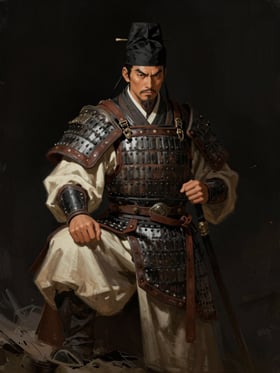
Wang Kuang joined the anti-Dong Zhuo coalition; histories place his defeat at Heyang Ford, the novel at Lü Bu’s hands at Hulao Pass.
Life
In the novel: 1 chapter · In the Records: 3 volumes
Life?–191
Appearances
By chapter (4)
Novel
- 5
Records
- 1
- 6
- 23
On the boards
Compare with someone →Where this person ranks on each board.
Historical Record
Wang Kuang, courtesy name Gongjie, was from Taishan. He was known for being generous with his wealth, fond of giving, and chivalrous. Early in his career, he was recruited by the Grand General He Jin and, bearing an official tally, went to Xu Province to requisition five hundred crossbowmen, intending to travel west to the capital. By the time he arrived, He Jin had already been defeated, so Wang Kuang returned to his home district. He later became Administrator of Henei. In the first year of Chuping, Wang Kuang rose in arms alongside the eastern warlords Yuan Shu, Han Fu, Kong Zhou, Liu Dai, Yuan Shao, Zhang Miao, and others. They chose Yuan Shao as their alliance leader, and Wang Kuang joined the coalition against Dong Zhuo in his capacity as Administrator of Henei.
Wang Kuang stationed troops from Taishan at Heyang Ford, intending to attack Dong Zhuo. Dong Zhuo first used a feint, pretending that he would cross the river at Pingyin, but secretly sent elite troops to cross north of Xiaoping and circle around to strike the rear of Wang Kuang’s army. He routed them north of the ford, and Wang Kuang’s troops were almost entirely killed or wounded. This made Dong Zhuo even more fearful of the eastern heroes rising together. He subsequently moved the emperor to Chang'an, burned the palaces at Luoyang, and had the imperial tombs excavated.
Dong Zhuo once sent the Commandant of Justice Humu Biao and the Director of Palace Construction Wu Xiu with an imperial edict to persuade Yuan Shao. Yuan Shao ordered Wang Kuang to kill Humu Biao. The “Book of the Later Han by Xie Cheng,” cited in Pei Songzhi’s commentary, says that Humu Biao was Wang Kuang’s brother-in-law. Wang Kuang had once imprisoned him, and he ultimately died in custody. This shows that Wang Kuang was both a local official on the side opposing Dong Zhuo and a man who, on Yuan Shao’s orders, dealt harshly with an envoy.
The sources also record that Wang Kuang governed his commandery harshly. He sent students to the subordinate counties to secretly investigate the offenses of officials and commoners, then arrested them and demanded money and grain as ransom; if they delayed, he implicated their clans. When Chang Lin’s uncle was reported for whipping a household retainer, Wang Kuang grew angry and had him taken into custody. Chang Lin asked Humu Biao to deliver a letter admonishing Wang Kuang, who eventually pardoned his uncle.
In the Novel
Romance of the Three Kingdoms lists Wang Kuang as one of the seventeen warlords who responded to Cao Cao’s proclamation, and identifies him as the fifth lord, the Administrator of Henei. The novel gives him a role in bringing the coalition together: after the warlords assembled, he proposed that, since they were acting in the name of righteousness, they should first appoint an alliance leader and all submit to his authority. Cao Cao immediately nominated Yuan Shao, and the others acclaimed him as their leader. This scene portrays Wang Kuang as a speaker who values military discipline and order within the alliance. The Records of the Three Kingdoms records that the warlords chose Yuan Shao as their leader, but does not describe Wang Kuang proposing the appointment or explain how it came about.
In the Battle of Hulao Pass, the novel says that Wang Kuang was ordered to lead troops against the enemy and arrived before the other warlords. When he saw Lü Bu ride out, he asked who would dare face him. His officer Fang Yue charged with a spear, but Lü Bu killed him in fewer than five bouts. Wang Kuang’s army then broke and fled; only after the armies of Qiao Mao and Yuan Yi arrived to rescue them did Lü Bu withdraw. The episode depicts Wang Kuang’s forces faltering before a formidable warrior and his reliance on allied troops to extricate him. The historical defeat at Heyang Ford, where Dong Zhuo routed Wang Kuang, and the novel’s defeat by Lü Bu at Hulao Pass are separate events. Fang Yue’s death and Wang Kuang’s retreat at Hulao Pass belong to the novel’s portrayal and are not recorded in the Records of the Three Kingdoms.
Key Relationships
Yuan Shao was the leader of the alliance Wang Kuang joined to oppose Dong Zhuo, and in the novel he is the leader whom Wang Kuang proposes elevating. The historical record only confirms that the warlords chose Yuan Shao together, and records that Wang Kuang killed Humu Biao on Yuan Shao’s orders. Dong Zhuo was the enemy Wang Kuang marched against; he routed Wang Kuang’s troops at Heyang Ford with a flanking attack. The novel, by contrast, portrays Lü Bu as the enemy general who directly defeats Wang Kuang’s army at Hulao Pass. Humu Biao was both an envoy sent by Dong Zhuo with an imperial edict and Wang Kuang’s brother-in-law; he ultimately died while in Wang Kuang’s custody. Chang Lin sought help after Wang Kuang took his uncle into custody, and used Humu Biao’s admonition to secure his uncle’s release.
Signature Scenes
The historical record describes Wang Kuang deploying troops at Heyang Ford. Dong Zhuo used the pretense of crossing at Pingyin to draw him into responding, then crossed north of Xiaoping and circled around to attack his rear, inflicting a crushing defeat. The battle both depicts Wang Kuang taking the field against Dong Zhuo and shows how Dong Zhuo prevailed through feints and a flanking maneuver. Another scene concerns Chang Lin pleading for his uncle. Confronted with the force of Wang Kuang’s harsh rule, Chang Lin first explained to Humu Biao the importance, in troubled times, of employing people and showing kindness; Humu Biao then sent Wang Kuang a letter of admonition, ultimately persuading him to change his decision.
The novel’s signature scene is Wang Kuang proposing that the warlords appoint an alliance leader in their camp, thereby prompting them to acclaim Yuan Shao. He then leads his troops to Hulao Pass ahead of the others, where he retreats after Fang Yue is killed and escapes through the intervention of Qiao Mao and Yuan Yi. The first scene presents him as a participant in the alliance’s deliberations; the second sets him against Lü Bu’s prowess. Both are specific narrative episodes unique to the novel.
Lines
- 演 ch.5 §29🗓 The Three Visits (to the Thatched Cottage)
「今奉大義,必立盟主;眾聽約束,然後進兵。」
- 演 ch.5 §46
「誰敢出戰?」
- Other
Who is Wang Kuang connected to?
Pick someone to see how many steps lie between them and Wang Kuang.
History vs. novel
6 points · 2 novel-only
| History | Novel |
|---|---|
| Defeat at Heyang FordHistory only | |
Wang Kuang stationed troops from Mount Tai at Heyang Ford, preparing to attack Dong Zhuo. Dong Zhuo used decoys to hold them in place, then led elite troops north across the river at Xiaoping and launched a surprise attack from the rear. Wang Kuang's army was almost completely wiped out. vol. 6 | — |
| Nominating Yuan ShaoNovel only | |
| — | Wang Kuang argued that they should first appoint an alliance leader and unify their command before advancing. The assembled warlords nominated Yuan Shao as their leader; Yuan Shao initially declined but later accepted. ch. 5 |
| Fang Yue fights Lü BuNovel only | |
| — | Wang Kuang asked who would dare to fight. His general Fang Yue answered Lü Bu's challenge, but was knocked from his horse in fewer than five bouts. Wang Kuang's army promptly collapsed. ch. 5 |
| Dong Zhuo moves the capital and burns LuoyangHistory only | |
In the second month of the first year of Chuping, Dong Zhuo moved the emperor's capital to Chang'an, then burned the palaces and buildings in Luoyang and plundered the tombs for treasures. vol. 6 | — |
| Dong Zhuo's Meiwu fortressHistory only | |
Dong Zhuo built Meiwu, a fortress as large as Chang'an, with enough stored grain to last thirty years. He said that if he succeeded, he could rule the realm; if not, it would still be enough to see him through old age. vol. 6 | — |
| Dong Zhuo kills surrendered rebels at a banquetHistory only | |
Dong Zhuo lured several hundred rebels from Beidi into surrender. At a banquet, he had their tongues cut out, their limbs severed, their eyes gouged out, or had them thrown into a cauldron to be boiled. The assembled ministers were terrified, but he continued eating and drinking as usual. vol. 6 | — |
- Defeat at Heyang FordHistory only
- History
Wang Kuang stationed troops from Mount Tai at Heyang Ford, preparing to attack Dong Zhuo. Dong Zhuo used decoys to hold them in place, then led elite troops north across the river at Xiaoping and launched a surprise attack from the rear. Wang Kuang's army was almost completely wiped out.
vol. 6
- Nominating Yuan ShaoNovel only
- Novel
Wang Kuang argued that they should first appoint an alliance leader and unify their command before advancing. The assembled warlords nominated Yuan Shao as their leader; Yuan Shao initially declined but later accepted.
ch. 5
- Fang Yue fights Lü BuNovel only
- Novel
Wang Kuang asked who would dare to fight. His general Fang Yue answered Lü Bu's challenge, but was knocked from his horse in fewer than five bouts. Wang Kuang's army promptly collapsed.
ch. 5
- Dong Zhuo moves the capital and burns LuoyangHistory only
- History
In the second month of the first year of Chuping, Dong Zhuo moved the emperor's capital to Chang'an, then burned the palaces and buildings in Luoyang and plundered the tombs for treasures.
vol. 6
- Dong Zhuo's Meiwu fortressHistory only
- History
Dong Zhuo built Meiwu, a fortress as large as Chang'an, with enough stored grain to last thirty years. He said that if he succeeded, he could rule the realm; if not, it would still be enough to see him through old age.
vol. 6
- Dong Zhuo kills surrendered rebels at a banquetHistory only
- History
Dong Zhuo lured several hundred rebels from Beidi into surrender. At a banquet, he had their tongues cut out, their limbs severed, their eyes gouged out, or had them thrown into a cauldron to be boiled. The assembled ministers were terrified, but he continued eating and drinking as usual.
vol. 6
Events
Events (2)
Battles and events the texts place this person in, by date.
Battles
Other events
Places
- Native of
- Taishan CommanderyRecords
Continue
Chang Lin
Advises
Relationship timeline1 entry ▸
History · vol. 6
Fights
the Administrator of Henei sent Taishan troops to garrison Heyang Ford, intending to move against Zhuo; Zhuo thoroughly defeated them north of the ford
Inner monologues · AI-generated1 monologue ▸
- I am Wang Kuang, courtesy name Gongjie. As the Administrator of Henei, I joined the lords of the east in raising an army