Yellow Turban Army · Subordinate General
Zhou Cang
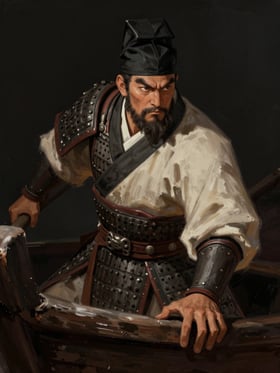
Zhou Cang, Guan Yu's loyal officer in Romance of the Three Kingdoms, killed himself at Maicheng; the Records of the Three Kingdoms omit him.

Life
In the novel: 8 chapters
Life?–?
200 CE (Jian'an 5)
Allegiance
- Liu Bei's faction
- Yellow Turban Army
- Hatched: dated by chapter
- Life event
List all 2 stops
- Gucheng200Reunion of Brothers at Gucheng
- MaichengDied here
On the boards
Compare with someone →Where this person ranks on each board.
Historical Record
The Records of the Three Kingdoms makes no mention of Zhou Cang; he appears only in novels such as Romance of the Three Kingdoms. The surviving Records of the Three Kingdoms provides no material on which to base an account of his life, identity, or deeds. His birthplace, experiences, and fate as described in the novel therefore cannot be treated as historical fact. All the specific details of Zhou Cang’s character and deeds below are creations of the novel.
In the Novel
Romance of the Three Kingdoms portrays Zhou Cang as a loyal and valiant retainer and officer under Guan Yu. Originally from Guanzhong, he had served as an officer under Zhang Bao of the Yellow Turban Army. After Zhang Bao’s death, he gathered followers in the mountains and forests. The novel describes his appearance and physique as “dark-faced and tall,” with a barrel chest, a bristling beard, and arms said to possess the strength of a thousand catties. It then has him leave his life in the mountains to become Guan Yu’s follower, inspired by his admiration for Guan Yu’s great reputation. These details of identity, appearance, and experience belong to literary storytelling; the Records of the Three Kingdoms does not record them.
Zhou Cang’s character is defined less by strategy than by his rough-hewn directness and sincerity. When he saw Guan Yu, he dismounted and bowed low, begging to be accepted as a foot soldier and declaring that he would gladly hold the whip and follow at his stirrup, even if it meant “dying content.” At first, Guan Yu worried that the number of followers would make it inconvenient to travel. Zhou Cang offered to dismiss his men and follow on foot by himself. Only after Lady Gan agreed that one or two men could accompany him did he follow Guan Yu’s order and part ways with Pei Yuanshao. This episode presents loyalty as a willing choice to give up one’s former followers and humbly accompany one’s new lord.
The novel then gradually establishes Zhou Cang as a trusted officer in Guan Yu’s army. He is ordered to gather the men of Woniu Mountain, and later fights alongside Guan Yu and Guan Ping. During the period in Jing Province, he is among the officers who assist Guan Yu in defending the province. His strength is also linked to his skill in water combat: after the Flooding of the Seven Armies at Fancheng, Zhou Cang, an adept swimmer, uses a large raft to ram and overturn Pang De’s small boat, then leaps into the water and captures him. This is one of the clearest demonstrations of his bravery.
Key Relationships
Guan Yu is Zhou Cang’s commander and the central figure in his story. Admiring Guan Yu, Zhou Cang joins him and later follows him in battle and in the defense of Jing Province. He obeys Guan Yu’s orders and, at crucial moments, responds to his commander’s plans through decisive action. The novel thus portrays Zhou Cang as Guan Yu’s loyal officer, not as an independent political or military leader.
Pei Yuanshao was Zhou Cang’s companion from the days when they gathered followers in the mountains. After Guan Yu allowed Zhou Cang to join him, Zhou Cang entrusted his followers to Pei Yuanshao and agreed that Pei would come to join him once they had settled. Later, when Zhou Cang was ordered to gather the men of Woniu Mountain, he learned that Zhao Yun had killed Pei Yuanshao. Zhou Cang fought Zhao Yun and was wounded, then reported the matter to Liu Bei. This episode both explains Zhou Cang’s ties to his former followers and shows that his loyalty had shifted to Guan Yu and Liu Bei.
Wang Fu was Zhou Cang’s fellow defender when he was left to hold Maicheng. Before Guan Yu attempted a breakout, he left Zhou Cang behind and ordered him to defend the city with Wang Fu. When Wu forces tried to persuade them to surrender by displaying the severed heads of Guan Yu and his son, Wang Fu fell from the city wall and died, while Zhou Cang killed himself with his sword in devotion to his lord. Zhou Cang’s death completes his portrayal as a figure of loyalty and righteousness; this episode, like the related characters’ experiences, is unique to the novel.
Signature Scenes
Joining Guan Yu at the foot of Woniu Mountain (unique to the novel): Hearing that Guan Yu had arrived, Zhou Cang hurried over with his followers. At their first meeting, he dismounted, bowed low, and asked to become a foot soldier. Rather than withdraw because his followers could not accompany him, he offered to go alone on foot, undeterred by a journey of ten thousand li. With Lady Gan’s approval, he was able to follow Guan Yu. Their meeting sets the tone for the literary story of Zhou Cang’s lifelong devotion to Guan Yu.
Holding the blade and acting on cue at Guan Yu Attends the Meeting Armed with a Single Blade (unique to the novel): When Guan Yu went to Lu Su’s banquet, Zhou Cang stood nearby holding the great blade. During the feast, Zhou Cang loudly declared, “The lands under Heaven belong only to those who possess virtue.” Guan Yu at once pretended to be angry, seized the blade, and sent him away with a rebuke. Understanding the signal, Zhou Cang hurried to the riverbank and waved a red flag, whereupon the boats prepared by Guan Ping came to meet them. In this episode, Zhou Cang shows his outspokenness while helping Guan Yu escape by playing his part in the signal.
Capturing Pang De and dying in devotion at Maicheng (unique to the novel): After the Flooding of the Seven Armies, Zhou Cang draws on his strength and swimming skill to overturn the small boat carrying Pang De and capture him in the water. Near the end of the story, Zhou Cang is ordered to remain at Maicheng; upon hearing that Guan Yu and his son have been captured and killed, he takes his own life. The first episode highlights his physical prowess, while the second turns his bravery into a death faithful to his lord. Together, they form Zhou Cang’s most striking heroic image in the novel.
Quotes
10 lines in the books · 3 featured
「舊隨黃巾張寶時,曾識尊顏;恨失身賊黨,不得相隨。今日幸得拜見。願將軍不棄,收為步卒,早晚執鞭隨鐙,死亦甘心!」
This line shows Zhou Cang's loyalty and devotion to Guan Yu, the heart of his characterization.
「倉乃一粗莽之夫,失身為盜;今遇將軍,如重見天日,豈忍復錯過?若以眾人相隨為不便,可令其盡跟裴元紹去。倉隻身步行,跟隨將軍,雖萬里不辭也!」
Zhou Cang vows to follow Guan Yu to the death, highlighting his loyalty and shaping the classic image of the devoted guardian.
「天下土地,惟有德者居之。豈獨是汝東吳當有耶?」
This line embodies Zhou Cang's boldness and his defense of the legitimacy of Liu Bei's faction, carrying strong cultural recognizability.
- Lord & vassal
- Friends
Who is Zhou Cang connected to?
Pick someone to see how many steps lie between them and Zhou Cang.
Events
Events (6)
Battles and events the texts place this person in, by date.
Places
Continue
Reunion of Brothers at Gucheng
Relationship timeline6 entries ▸
Novel · ch. 28
Novel · ch. 31
- Guan Yu§24
Friend
A subordinate of Guan Yu; followed along with Guan Ping (followed him out of loyalty)
Novel · ch. 66
- Guan Yu§7
Lord
At Duan 7, held up the great saber and stood to the side; at Duan 10, loudly supported his lord from below the steps; used a red flag as the signal
Novel · ch. 74
- Guan Yu§12
Commands
subordinate general; propelled a raft into Pang De's small boat, capsizing it, then jumped into the water and captured him alive
Novel · ch. 77
- Guan Yu§17
Lord
Guan Gong’s subordinate; upon hearing of his death, killed himself by slitting his own throat
Inner monologues · AI-generated3 monologues ▸
- I, Zhou Cang, followed my lord, General Guan, through the world of rivers and lakes. What I saw and experienced often la
- Back in the days beneath Wo Niu Mountain, after Pei Yuanshao was run through by a mounted warrior, I led my old companio
- I am Zhou Cang, a native of Guanzhong. I recall that I once served as a general under Zhang Bao of the Yellow Turbans. A