Liu Tao
courtesy name 子奇 · –185
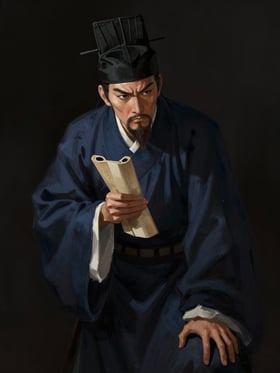
Liu Tao, son of Cao Wei’s Liu Ye, was recorded as Pingyuan governor; the Romance depicts him remonstrating with the Ten Attendants.
On the boards
Compare with someone →Where this person ranks on each board.
Liu Tao, courtesy name Ziqi, was Liu Ye’s youngest son. He appears in Chapter 2 of Romance of the Three Kingdoms as an Admonishing Official.
Deeds
Historical records describe Liu Tao as highly talented but lacking in personal conduct. He rose to the post of Administrator of Pingyuan. Pei Songzhi’s commentary says he was skilled in debating strategy and possessed great eloquence. During Cao Shuang’s time, he was appointed as a Selection Department Gentleman and won the praise of Deng Yang and others. (Historical record)
When Guanqiu Jian rebelled, the Grand General questioned Liu Tao, who gave an evasive answer. The Grand General flew into a rage and sent him out to serve as Administrator of Pingyuan, then later pursued and killed him. (Historical record)
In Chapter 2 of Romance of the Three Kingdoms, Liu Tao goes straight before the emperor and weeps bitterly, accusing the Ten Attendants of selling offices, harming the people, and deceiving the emperor. The emperor angrily orders him executed, but Chen Dan intervenes. Liu Tao and Chen Dan are then imprisoned. (Novel)
Relationships
- Son of Liu Ye.
- In the novel, imprisoned alongside Chen Dan.
In the sources
Where the books name Liu Tao
History · vol. 14Records of the Three Kingdoms
…〈《王弼傳》曰:淮南人劉陶,善論縱橫,為當時所推。《傅子》曰:陶字季冶,善名稱,有大辯。…
Read the whole paragraph
少子陶,亦高才而薄行,官至平原太守。〈《王弼傳》曰:淮南人劉陶,善論縱橫,為當時所推。《傅子》曰:陶字季冶,善名稱,有大辯。曹爽時為選部郎,鄧颺之徒稱之以為伊呂。當此之時,其人意陵青雲,謂玄曰:「仲尼不聖。何以知其然?智者圖國;天下羣愚,如弄一丸於掌中,而不能得天下。」玄以其言大惑,不復詳難也。謂之曰:「天下之質,變無常也。今見卿窮!」爽之敗,退居里舍,乃謝其言之過。干寶《晉紀》曰:毌丘儉之起也,大將軍以問陶,陶答依違。大將軍怒曰:「卿平生與吾論天下事,至於今日而更不盡乎?」乃出為平原太守,又追殺之。〉
History · vol. 14Records of the Three Kingdoms
=== 子 陶 ===
Novel · ch. 2Romance of the Three Kingdoms
一日,帝在後園與十常侍飲宴,諫議大夫劉陶,逕到帝前大慟。帝問其故。…
Read the whole paragraph
一日,帝在後園與十常侍飲宴,諫議大夫劉陶,逕到帝前大慟。帝問其故。陶曰:「天下危在旦夕,陛下尚自與閹官共飲耶!」帝曰:「國家承平,有何危急?」陶曰:「四方盜賊並起,侵掠州郡。其禍皆由十常侍賣官害民,欺君罔上。朝廷正人皆去,禍在目前矣!」十常侍皆免冠跪伏於帝前曰:「大臣不相容,臣等不能活矣!願乞性命歸田里,盡將家產以助軍資。」言罷痛哭。帝怒謂陶曰:「汝亦有近侍之人,何獨不容朕耶?」呼武士推出斬之。劉陶大呼:「臣死不惜!可憐漢室天下,四百餘年,到此一旦休矣!」
Quotes
3 lines in the books · 3 featured
「天下危在旦夕,陛下尚自與閹官共飲耶!」
A direct rebuke of the emperor for indulging in pleasure while ignoring the peril of the realm; sharply critical in spirit.
「四方盜賊並起,侵掠州郡。其禍皆由十常侍賣官害民,欺君罔上。朝廷正人皆去,禍在目前矣!」
Pinpoints the misrule of the Ten Attendants as the root of the empire's chaos, exposing the core conflict of the late Eastern Han.
「臣死不惜!可憐漢室天下,四百餘年,到此一旦休矣!」
Foretells the fall of the Han house; grief and indignation overflow, a portrait of his loyal and righteous character.
Family, lords and rivals
1 relationships
Who is Liu Tao connected to?
Pick someone to see how many steps lie between them and Liu Tao.
History vs. novel
8 points · 2 novel-only
| History | Novel |
|---|---|
| Identity and Official PostSources disagree | |
Historical records state that Liu Tao was Liu Ye’s youngest son and rose to the post of Administrator of Pingyuan; the Fuzi gives his courtesy name as Jiye. vol. 14 | The novel calls Liu Tao a Gentleman of Remonstrance and depicts him speaking frankly to Emperor Ling of Han; it does not mention his family background or his historical tenure as Administrator of Pingyuan. ch. 2 |
| Talent and CharacterHistory only | |
Historical records state that Liu Tao was highly talented but weak in character, skilled in debate and political argument, and respected by his contemporaries. vol. 14 | — |
| Compared to Yi Yin and Lü ShangHistory only | |
When Cao Shuang was in power, Liu Tao was appointed a Secretariat Official, and Deng Yang and others compared him to Yi Yin and Lü Shang. vol. 14 | — |
| Confucius Was No SageHistory only | |
Liu Tao once claimed that Confucius was not a sage, and boasted that a wise man could hold all-under-Heaven in the palm of his hand. After Cao Shuang’s downfall, he withdrew to his home village and apologized for these words. vol. 14 | — |
| Guanqiu Jian’s RebellionHistory only | |
When Guanqiu Jian rose in revolt, the General-in-Chief asked Liu Tao for his opinion, but Liu Tao gave an evasive answer. The General-in-Chief was angered and subsequently sent him out to serve as Administrator of Pingyuan. vol. 14 | — |
| Reason for His ExecutionSources disagree | |
Historical records state that Liu Tao was sent out to serve elsewhere for giving an evasive answer about Guanqiu Jian’s rebellion, and was pursued and killed afterward. vol. 14 | The novel says Liu Tao was ordered beheaded for impeaching the Ten Attendants to their faces and condemning Emperor Ling. ch. 2 |
| Remonstrance in the Rear GardenNovel only | |
| — | Liu Tao stormed into the rear garden where Emperor Ling and the Ten Attendants were feasting, denounced the eunuchs to their faces for selling offices and harming the people, and warned that the realm was in peril. ch. 2 |
| His Lament Before ExecutionNovel only | |
| — | As he was led out to be beheaded, Liu Tao cried that he did not fear death and lamented that the Han dynasty’s more than four-hundred-year legacy was nearing its end. ch. 2 |
- Identity and Official PostSources disagree
- History
Historical records state that Liu Tao was Liu Ye’s youngest son and rose to the post of Administrator of Pingyuan; the Fuzi gives his courtesy name as Jiye.
vol. 14
- Novel
The novel calls Liu Tao a Gentleman of Remonstrance and depicts him speaking frankly to Emperor Ling of Han; it does not mention his family background or his historical tenure as Administrator of Pingyuan.
ch. 2
- Talent and CharacterHistory only
- History
Historical records state that Liu Tao was highly talented but weak in character, skilled in debate and political argument, and respected by his contemporaries.
vol. 14
- Compared to Yi Yin and Lü ShangHistory only
- History
When Cao Shuang was in power, Liu Tao was appointed a Secretariat Official, and Deng Yang and others compared him to Yi Yin and Lü Shang.
vol. 14
- Confucius Was No SageHistory only
- History
Liu Tao once claimed that Confucius was not a sage, and boasted that a wise man could hold all-under-Heaven in the palm of his hand. After Cao Shuang’s downfall, he withdrew to his home village and apologized for these words.
vol. 14
- Guanqiu Jian’s RebellionHistory only
- History
When Guanqiu Jian rose in revolt, the General-in-Chief asked Liu Tao for his opinion, but Liu Tao gave an evasive answer. The General-in-Chief was angered and subsequently sent him out to serve as Administrator of Pingyuan.
vol. 14
- Reason for His ExecutionSources disagree
- History
Historical records state that Liu Tao was sent out to serve elsewhere for giving an evasive answer about Guanqiu Jian’s rebellion, and was pursued and killed afterward.
vol. 14
- Novel
The novel says Liu Tao was ordered beheaded for impeaching the Ten Attendants to their faces and condemning Emperor Ling.
ch. 2
- Remonstrance in the Rear GardenNovel only
- Novel
Liu Tao stormed into the rear garden where Emperor Ling and the Ten Attendants were feasting, denounced the eunuchs to their faces for selling offices and harming the people, and warned that the realm was in peril.
ch. 2
- His Lament Before ExecutionNovel only
- Novel
As he was led out to be beheaded, Liu Tao cried that he did not fear death and lamented that the Han dynasty’s more than four-hundred-year legacy was nearing its end.
ch. 2
Places
- Governed
- PingyuanRecords
Continue
Liu Ye
Kin
Relationship timeline1 entry ▸
History · vol. 14
- Liu Ye§95
Kin
Liu Ye’s youngest son
Inner monologues · AI-generated1 monologue ▸
- I am Liu Tao. Once, while serving as an Admonition Grandee, I saw the Son of Heaven feasting with the Ten Attendants in