Eastern Wu · Astrologer
Zhao Da
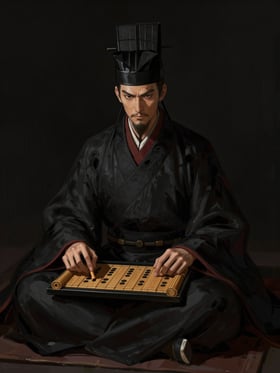
Two accounts of Zhao Da: a Wei inspector executed for illicit gain, and an Eastern Wu mathematician famed for Nine Palaces calculations.

Appearances
In the Records: 3 volumes
- Eastern Wu· Undated
On the boards
Compare with someone →Where this person ranks on each board.
Historical Record
The Records of the Three Kingdoms contains two accounts of men named Zhao Da: one was an inspector during the time of Wei Grand Ancestor Cao Cao, while the other, recorded in juan 63 of the Records of the Three Kingdoms, was a native of Henan renowned for his skill in calculation. The sources do not state that they were the same person, so their accounts should be kept separate and not conflated.
Cao Cao appointed Lu Hong, Zhao Da, and others as inspectors to keep watch over his subordinates. Gao Rou argued that establishing inspectors ran counter to the principle of dividing responsibilities, and pointed out that Zhao Da and the others abused their authority according to their likes and dislikes; he urged that they be investigated. Cao Cao defended them, saying that if inspectors were appointed from among the worthy, they could expose wrongdoing and investigate all manner of affairs. Later, when Zhao Da and the others were exposed for corrupt dealings, Cao Cao had them executed, thereby apologizing to Gao Rou. Another account relates that the inspector Zhao Da was ordered to question Xu Miao about Cao Cao’s affairs. Xu Miao, drunk, replied, “A sage within.” Zhao Da reported this to Cao Cao, who flew into a rage. Xu Miao was ultimately spared punishment after Xianyu Fu explained that “a sage within” was what drunkards called clear liquor.
The Zhao Da recorded in juan 63 was a native of Henan. As a young man, he studied under Shan Fu, a Palace Attendant of the Han, and later, believing that a ruler would rise in the southeast, crossed the river to escape the troubles. He mastered the Nine Palaces and One Calculation, thought with great precision, and could work out calculations rapidly; accounts say that his predictions, including estimates of locust numbers and guessing hidden objects by touch, often proved accurate. When Sun Quan went to war, he often had Zhao Da make predictions, and the results were usually as Zhao Da had foretold. But Zhao Da refused to explain his methods, so Sun Quan regarded him lightly, and he never rose to prominence or high office. The Wu Shu, quoted in Pei Songzhi’s annotations, also records that after Sun Quan Proclaims Himself Emperor, he once asked Zhao Da to calculate how long the state would endure; the number of years Zhao Da gave later proved accurate.
Zhao Da guarded his secret arts jealously and was reluctant to pass them on. The celebrated scholars Kan Ze and Yin Li once humbled themselves to seek instruction but were refused. Gongsun Teng, an Assistant Director of Astronomy, studied under him for many years. Zhao Da once agreed to teach him, but ultimately called it off, claiming that his plain-text book had been lost. Zhao Da once privately calculated the date of his own death and told his wife, then changed his prediction to console her. In the end, however, he died as he had first calculated. Sun Quan sent people to ask for his book but could not obtain it; they questioned Zhao Da’s daughter and searched his coffin, yet found no written instructions. The account says that his art died with him.
In the Novel
This person does not appear in the novel. The available sources provide no plot involving Zhao Da or characterization of him in Romance of the Three Kingdoms, so no fictional portrayal can be reconstructed from them. The inspector episodes and the accounts of his Nine Palaces calculations belong to the Records of the Three Kingdoms and Pei Songzhi’s annotations, not to any recoverable episode in the novel.
Key Relationships
The inspector Zhao Da served alongside Lu Hong among the surveillance officials appointed by Cao Cao. When Gao Rou criticized them, Cao Cao defended the role of such inspectors; later, however, Zhao Da and the others were executed after their corrupt dealings came to light, a response by Cao Cao to Gao Rou’s criticism. Zhao Da also acted as the reporter in the incident involving Xu Miao’s drunkenness: Xu Miao answered, “A sage within,” and Zhao Da reported him. Xu Miao was spared punishment only after Xianyu Fu intervened to explain the phrase.
The calculating Zhao Da’s line of instruction began with Shan Fu. Accounts also relate that Kan Ze and Yin Li sought to study under him, and that Gongsun Teng studied with him for many years but never truly obtained his secret arts. Zhao Da once made predictions about Sun Quan’s military affairs, but because he refused to disclose his methods, he failed to gain prominence. The prediction about how long the state would endure after Sun Quan Proclaims Himself Emperor appears in the Wu Shu quoted in Pei Songzhi’s annotations. These relationships all belong to the life of the calculating Zhao Da recorded in juan 63 and must not be conflated with the inspector Zhao Da who served under Cao Cao.
Defining Scenes
The scene that best captures the inspector Zhao Da’s role is Gao Rou confronting him and Lu Hong, accusing them of abusing their authority out of personal likes and dislikes and demanding an investigation. Cao Cao initially insisted that inspectors served to expose wrongdoing, but later executed the two when their corrupt dealings came to light. In the case of Xu Miao’s drunkenness, Zhao Da reported the words “A sage within” to Cao Cao, and Xu Miao’s drunken remark, uttered under a ban on alcohol, nearly brought him punishment.
A defining scene for the calculating Zhao Da has him estimating a quantity of small beans at a banquet, with the count later verified as correct. On another occasion, relying only on the conversation at the table and the way the host handled his chopsticks, he identified the wine and venison the host had hidden, astonishing everyone present. The story of his refusal to pass on his secret arts is just as striking: Gongsun Teng was finally granted permission to study, but when he arrived at the appointed time to receive the book, Zhao Da told him it had been lost, ending their relationship as teacher and pupil. And the account of Zhao Da calculating the date of his own death, trying to reassure his wife by revising his prediction, yet ultimately dying when he had first foreseen, brings the life of this practitioner of the arts to its close.
Quotes
8 lines in the books · 3 featured
「但有名無實。」
This line became the source of the idiom 'in name only' (youming-wushi), which endures to this day.
「吾先人得此術,欲圖爲帝王師,至仕來三世,不過太史郎,誠不欲復傳之。且此術微妙,頭乘尾除,一算之法,父子不相語。然以子篤好不倦,今真以相授矣。」
Shows the mystery and rigor of transmitting the arts of numerology in ancient times, an embodiment of the character's core traits.
「當迴算帷幕,不出戶牖以知天道,而反晝夜暴露以望氣祥,不亦難乎!」
Reflects the ancients' deep understanding of astronomy and their critical thinking about the art of reading the stars.
- Teacher & student
Who is Zhao Da connected to?
Pick someone to see how many steps lie between them and Zhao Da.
Combat
On the field
Duels, kills and executions as the texts tell them, counted separately for the Records and the Romance.
- RecordsJuan 24ExecutionCao CaoLost「達等後姧利發,太祖殺之以謝於柔」
Events
Events (1)
Battles and events the texts place this person in, by date.
Other events
Places
- Native of
- Henan Commandery (Henan Yin)Records
Continue
Gao Rou's Administration of Criminal Law
Relationship timeline1 entry ▸
History · vol. 63
- Shan Fu§21
Teacher
Studied under Shan Fu, an Attendant of the Han court, from a young age
Inner monologues · AI-generated1 monologue ▸
- I am Zhao Da, a native of Henan. In my youth, I studied under Shan Fu, a Gentleman Attendant of the Han court. I was tho