Diao Chan
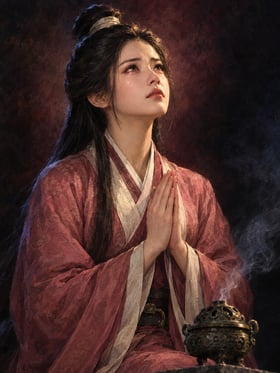
Diao Chan was just sixteen, excelling in both beauty and artistry. As she sang, her cherry-red lips parted like crimson and her voice was as broken jade scattering the warmth of spring; as she danced, she was like a startled swan.

Appearances
In the novel: 4 chapters
On the boards
Compare with someone →Where this person ranks on each board.
Who they were
Character profile
- Appearance
- Diao Chan was just sixteen, excelling in both beauty and artistry. As she sang, her cherry-red lips parted like crimson and her voice was as broken jade scattering the warmth of spring; as she danced, she was like a startled swan.
- Character
- Grateful and quick to repay kindness, decisive and clever, she was adept at using tears to move Lü Bu, at pleasing Dong Zhuo with gentle compliance, and at making flirtatious glances and amorous looks her instruments. Glib of tongue and quick to weep, she could feign drawing a sword to cut her own throat to make Dong Zhuo resolve to return to his fortress, and could cover her face as if crying in her carriage to provoke Lü Bu.
- Manner of speech
- Diao Chan's manner of speech was to declare her will in short phrases, such as 'I would not shrink from ten thousand deaths' and 'to die beneath ten thousand blades,' while she used longer sentences to pour out her feelings. Facing Lü Bu she spoke obliquely of the outrages done to her, bidding farewell and begging rescue; facing Dong Zhuo she demurred gracefully and flattered him.
- Anecdotes
- Diao Chan was a singing courtesan in Wang Yun's household, raised by Wang Yun from childhood as his own daughter. She played the central role in the Chain Stratagem: first promised to Lü Bu and then presented to Dong Zhuo, she successfully turned father and adopted son against each other. After the fall of the fortress of Meiwu she was taken first by Lü Bu and became his concubine; she once urged him, 'Make me your care, my lord, and do not ride out alone,' and spent her days drinking with Lü Bu alongside Lady Yan to dispel his cares.
Historical Record
The Records of the Three Kingdoms does not mention her; Diao Chan appears only in literary narratives such as Romance of the Three Kingdoms. (This section notes her absence from the historical record as required by the source materials.)
In the Novel
Romance of the Three Kingdoms portrays Diao Chan as a singing girl raised and taught from childhood in Wang Yun’s household. She is sixteen, beautiful and accomplished, and Wang Yun treats her like his own daughter. Knowing that Wang Yun is troubled by the Han court’s precarious situation, she offers to share his burden. Wang Yun then explains the chain stratagem: first promise her in marriage to Lü Bu, then present her to Dong Zhuo, using their rivalry to drive a wedge between father and son. She agrees to take part, and the story thereby places her at the center of political intrigue. (Unique to the novel)
She first meets Lü Bu at a banquet in Wang Yun’s home, exchanging glances with him and accepting the promise of marriage. Later, at a banquet hosted by Dong Zhuo, she dances, sings, and pours wine before being taken to Dong Zhuo’s residence. She wins Dong Zhuo’s favor by acting meek and accommodating, while with Lü Bu she feigns sorrow and wipes away tears to signal her distress. At Fengyi Pavilion, she weeps that Dong Zhuo has violated her and even pretends to throw herself into a pond. Through her contrasting words and actions toward the two men, the novel steadily deepens Lü Bu’s resentment and Dong Zhuo’s suspicions, turning private desire into political conflict. (Unique to the novel)
After Dong Zhuo catches her meeting Lü Bu at Fengyi Pavilion, Diao Chan tells him that Lü Bu tried to force himself on her and threatens to kill herself rather than submit. This prompts Dong Zhuo to decide to take her with him to Meiwu. Later, she hides her face and weeps in the carriage, further stirring Lü Bu’s emotions. Wang Yun seizes the opportunity to provoke Lü Bu by speaking of the insult, pushing him toward a decision to turn against Dong Zhuo. The novel thus makes the “beauty stratagem” a crucial part of the chain stratagem, but Diao Chan is not merely a passive victim: her consent, deft maneuvering, laments, and quick responses together drive the drama of the scheme. (Unique to the novel)
After Dong Zhuo is killed, Lü Bu enters Meiwu and takes Diao Chan away. The novel later recounts that she became Lü Bu’s concubine and bore no children. When Xiapi was besieged, she urged Lü Bu not to ride out of the city recklessly, and she also drank with Lü Bu and Lady Yan to dispel their gloom. In this way, the Diao Chan of the novel shifts from being central to the scheme to divide Dong Zhuo and Lü Bu to a figure in Lü Bu’s household, and the story gives her markedly less attention thereafter. (Unique to the novel)
Key Relationships
- Wang Yun: Diao Chan was raised from childhood in Wang Yun’s household, and he treated her as his own daughter. Grateful to him and willing to repay his kindness, she accepted the chain stratagem and became a key figure in Wang Yun’s plan. (Unique to the novel)
- Lü Bu: Wang Yun first promised Diao Chan in marriage to Lü Bu, who fell deeply in love with her. Through her glances, tears, and meeting with him at Fengyi Pavilion, Diao Chan sustained his affections; he was ultimately provoked into deciding to turn against Dong Zhuo. The novel also says that she later became Lü Bu’s concubine and urged him to act cautiously during the siege of Xiapi. (Unique to the novel)
- Dong Zhuo: Diao Chan was presented to Dong Zhuo at his residence, where he doted on her. Her entanglement with Lü Bu aroused Dong Zhuo’s suspicions, and as he moved to Meiwu, she responded to Lü Bu with tears. These relationships and their political consequences are all creations of the novel; the Records of the Three Kingdoms does not explicitly mention them. (Unique to the novel)
Signature Scenes
- Sighing beside the Peony Pavilion: Wang Yun hears Diao Chan sighing at night and learns that she has noticed his distress. She says she is willing to serve him, and the story uses this moment to introduce the chain stratagem. (Unique to the novel)
- The banquet and dancing before the curtain: Diao Chan first exchanges glances with Lü Bu at Wang Yun’s banquet, then dances and sings at Dong Zhuo’s banquet before being presented at his residence. The two scenes link the two ends of the stratagem. (Unique to the novel)
- The meeting at Fengyi Pavilion: Diao Chan weeps to Lü Bu that she has been violated and pretends to throw herself into a pond; Dong Zhuo then catches the two of them together. The scene brings their secret affection into the open and becomes a major dramatic turning point in the rift between father and son. (Unique to the novel)
- Hiding her face in the carriage to Meiwu: Dong Zhuo takes Diao Chan with him to Meiwu. She gazes back at Lü Bu from the carriage, hiding her face as if weeping bitterly. Lü Bu then confides in Wang Yun, who continues to inflame his resolve to turn against Dong Zhuo. (Unique to the novel)
Quotes
5 lines in the books · 3 featured
「妾在後園看花,呂布突至。妾方驚避,布曰:『我乃太師之子,何必相避?』提戟趕妾至鳳儀亭。妾見其心不良,恐為所逼,欲投荷池自盡,卻被這廝抱住。正在生死之間,得太師來,救了性命。」
This dialogue displays Diao Chan's scheme to sow discord between Dong Zhuo and Lü Bu, the heart of the 'interlocking stratagem.'
「妾身已事貴人,今忽欲下賜家奴,妾寧死不辱!」
This line accentuates Diao Chan's chastity and intelligence, an important shaping of her character.
「此必李儒之計也!儒與布交厚,故設此計;卻不顧惜太師體面與賤妾性命。妾當生噬其肉!」
This line reveals Diao Chan's ruthlessness and thirst for vengeance, making her character more fully rounded.
- Family
Who is Diao Chan connected to?
Pick someone to see how many steps lie between them and Diao Chan.
Events
Events (2)
Battles and events the texts place this person in, by date.
Battles
Other events
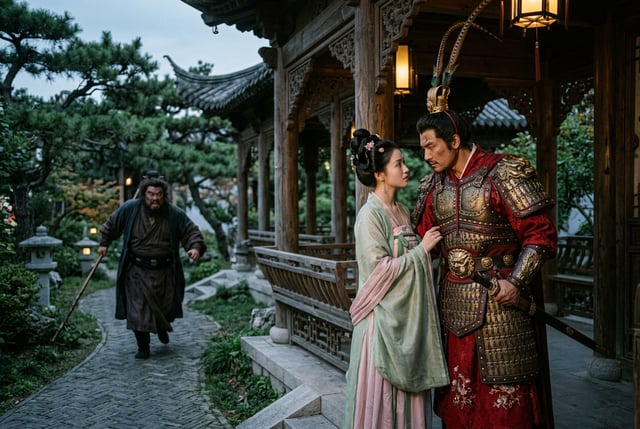
- 192Wang Yun's Interlocking StratagemInstigator
Continue
Wang Yun's Interlocking Stratagem
Relationship timeline7 entries ▸
Novel · ch. 8
- Wang Yun§4
Kin
A singing girl in the household; selected to enter the household in childhood, Wang Yun treated her as his own daughter; in this chapter, entrusted with carrying out the chain stratagem
- Lü Bu§6
Spouse
was permitted by Wang Yun to marry; exchanged flirtatious glances and loving looks; later, at Fengyi Pavilion, wept and declared, “I would rather die before you,” and pledged to be together in the next life
- Dong Zhuo§21
Spouse
Wang Yun presented her as a concubine; Zhuo “was captivated by her beauty and did not come out to attend to affairs for over a month”; Diao Chan ingratiated herself, and secretly gestured to Bu, pointing to her heart and then to Zhuo
Novel · ch. 9
Lord
"I have already served a noble lord"—formally, she had served Zhuo
- Wang Yun§2
Lord
Wang Yun’s adopted daughter; a pawn in the chain stratagem (“This must be Li Ru’s plan” concealed the true mastermind)
Novel · ch. 16
- Lü Bu§22
Spouse
the concubine he had married earlier, while at Xiaopei
Novel · ch. 19
- Lü Bu§21
Spouse
Urged, “Take responsibility for me; do not lightly ride out alone”
Inner monologues · AI-generated1 monologue ▸
- I was born in the residence of the Minister over the Masses. From childhood, I studied song and dance, and my lord treat