Background
In the late Han, warlords fought one another, and the passage of an army often meant looting and destruction. Fields were trampled, and the common people scattered in flight—this was the norm. Ever since raising his army, Cao Cao had attached great importance to farmland cultivation and the supply of grain. He knew that if an army lost the support of the people along its route, its logistics and its ability to recruit soldiers would both become unsustainable. The story of cutting off his hair in place of his head arose in this context: it is about military discipline, but also about how a commander handles the tension between “law” and “authority.”
The earliest account of this incident appears in the Cao Man Zhuan, quoted in Pei Songzhi’s commentary on the Records of the Three Kingdoms, “Annals of Wudi”. It is worth noting that the Cao Man Zhuan is a work openly hostile to Cao Cao. In the original, this story is not presented as an admirable anecdote; instead, it is grouped with episodes portraying Cao Cao as frivolous and lacking dignity, executing old associates, and using a grain officer’s head to quell public anger. These stories are meant to illustrate his harsh enforcement of the law and his skill in deception. The Cao Man Zhuan gives neither a year nor a location.
Main Figures
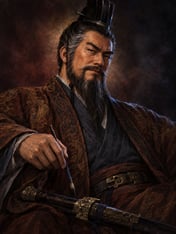
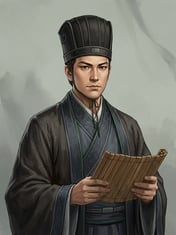
The only protagonists in the historical account are Cao Cao and an unnamed registrar. The registrar’s role is to cite the principle in the Spring and Autumn Annals that punishments do not apply to the honored, giving Cao Cao a way to avoid actually being punished. Cao Cao’s response is intriguing: he admits that he broke the law and also acknowledges that he cannot therefore be put to death. He then uses the symbolic punishment of cutting off his hair to uphold the posture that “the law makes no exception for oneself.”
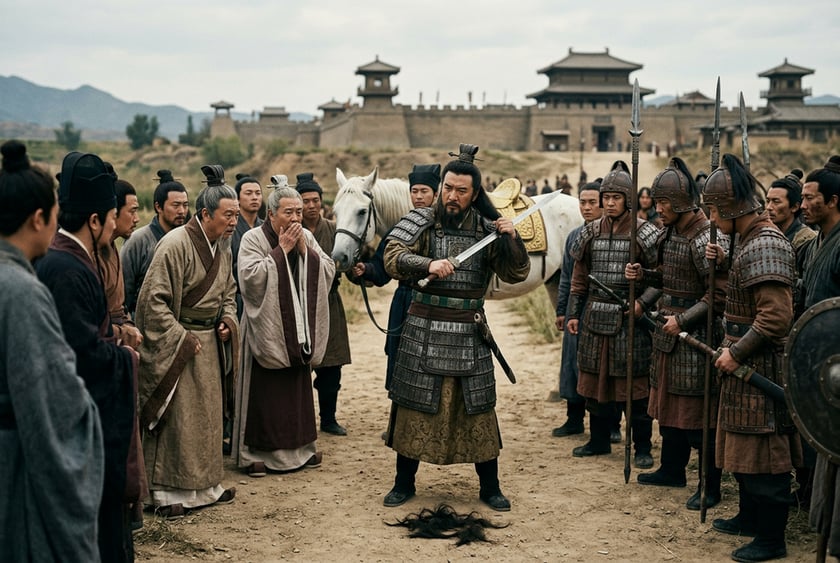
In the seventeenth chapter of Romance of the Three Kingdoms, Guo Jia takes the place of the man who tries to dissuade him. Guo Jia was one of Cao Cao’s most trusted strategists, and having him cite the classics makes the scene seem more like an unspoken collaboration between ruler and subject. The novel also sets the incident during the campaign against Zhang Xiu in the third year of Jian’an. Cao Cao first has notices issued to the people and officials along the route, after which the people line the road to thank him, forming a complete narrative sequence from making the law and obeying it to breaking it and being punished. The year and location are the novel’s inventions.
Central Issue
The central question is whether the supreme commander can be bound by the laws he himself has laid down. In Han-era thought, hair was received from one’s parents, so shaving it was itself a form of punishment (the penalty of shaving the head). Cutting off one’s hair was therefore not entirely frivolous; it did carry punitive force under the rites and law. But compared with decapitation, the two punishments were plainly not equivalent. What Cao Cao does here is use a measure of minimal cost but powerful symbolic meaning to demonstrate to the whole army the seriousness of the law, while preserving himself.
From the perspective of military command, this was quite effective. The novel says that after the hair was displayed to the three armies, all the troops became solemn and obeyed orders. In the historical account, the cavalrymen had already dismounted and held the wheat stalks aside as they passed, showing that the order itself had already been carried out. Cao Cao’s self-punishment was intended to close the loophole that “the commander is an exception.” From a political perspective, however, the incident also exposes the nature of power: the force of the law ultimately depends on how far those in power are willing to let it bind them, and they themselves determine the limits.
Political Consequences
The incident itself changed no battlefield outcome, but it had a profound effect on Cao Cao’s historical image. The Cao Man Zhuan places it within a framework of “cruelty and deceit,” aiming to expose the performative nature of Cao Cao’s actions. Later readers have often interpreted it in two ways: one side sees it as an example of strict military discipline and leading by example, while the other sees it as political manipulation and a calculated show of sincerity.
The treatment in Romance of the Three Kingdoms accommodates both sides. On the one hand, the novel devotes considerable space to scenes of the people rejoicing and the soldiers holding aside the wheat, affirming the effect of military discipline. On the other, Cao Cao draws his sword as if to kill himself, is hurriedly rescued by those around him, and accepts Guo Jia’s advice only after a long silence—a sequence with an unmistakably theatrical quality. Through details like these, the novel shapes the image of a capable yet crafty “villainous hero,” and the story of cutting off his hair in place of his head has become one of the best-known episodes associated with Cao Cao.
Counterfactual Analysis
If Cao Cao had done nothing after his horse trampled the wheat, his power at the time would have meant that no one could truly hold him to account. But the credibility of military orders would have suffered, and the generals and soldiers would have realized that the laws bound only those below them. In the late Han, when military discipline was generally lax, this example could have rendered the earlier order to protect the wheat fields completely ineffective.
Conversely, if Cao Cao had truly put himself to death according to the law, it would have been a wholly unnecessary tragedy and would have violated the principles of hierarchy and deference accepted by everyone at the time. Cutting off his hair was a compromise between the two: it prevented the law from being rendered meaningless without costing the commander his life. This approach of finding a symbolic way out between principle and reality recurs in many of Cao Cao’s later political decisions. For instance, he welcomed the emperor and honored the Han dynasty while retaining a firm grip on real power, carefully maintaining a calculated distance between form and substance.