Liu Ai
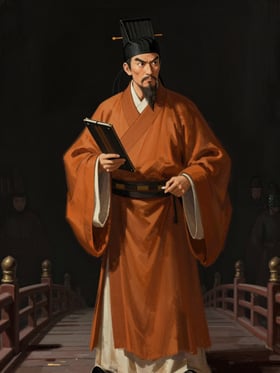
Liu Ai escorted Emperor Xian across a bridge and dissuaded him from drifting east; the novel also has him hear Wang Li discuss fate.
Appearances
In the novel: 1 chapter · In the Records: 3 volumes
By chapter (4)
Novel
- 14
Records
- 1
- 6
- 46
On the boards
Compare with someone →Where this person ranks on each board.
Historical Record
Liu Ai was a Palace Attendant in the late Eastern Han and had previously served as magistrate of Shan. Materials cited in Pei Songzhi’s annotations to the Records of the Three Kingdoms record how he escorted Emperor Xian’s carriage during the emperor’s flight from place to place and helped assess the dangers along the route. When the emperor left Xuanping Gate, Li Jue’s troops blocked the way at a bridge. Palace Attendant Liu Ai shouted, “That is the Son of Heaven!” and urged Yang Qi to raise the carriage curtain high so the soldiers blocking the road could identify the person inside. Only then was the imperial carriage able to pass. This incident shows how, in a crisis, he used his position as Palace Attendant to uphold the dignity of the Son of Heaven and help the imperial carriage escape danger.
Later, the emperor and his party made their way to Shan. When someone proposed taking a boat downriver to the east, Liu Ai, citing his past service as magistrate of Shan and his familiarity with the local hazards, supported Grand Commandant Yang Biao’s view. He pointed out that even with an army escort, they might capsize—and that they had no army to protect them at the time. The court therefore did not adopt the plan to travel east by river. His judgment was not abstract speculation but was based on his familiarity with the terrain and the risks of the journey.
The sources also show that Liu Ai was once ordered to take part in ceremonial duties connected with the Cao Wei regime. The Notes on Emperor Xian’s Daily Life, cited in Pei Songzhi’s annotations, records that he and Wang Yi went under imperial credentials to the State of Wei, where they welcomed two of Cao Cao’s daughters into the palace as Noble Ladies. When Cao Cao was elevated to King of Wei, Liu Ai, serving as Acting Censor-in-Chief and Director of the Imperial Clan, again went under imperial credentials to present him with the appointment document, seals, and ribbons. These accounts reveal his place in the Han court’s official hierarchy and the increasingly intertwined political environment of Han imperial ritual and Cao Cao’s power. The sources provide no material sufficient to fill in details of his early life, family background, or later years.
In the Novel
Chapter 14 of Romance of the Three Kingdoms places Liu Ai in a political discussion about moving the capital to Xu County and identifies him as Director of the Imperial Clan. Wang Li privately discusses celestial phenomena with him, explaining that the conjunction of Tai Bai and Ying Huo foretells a change of regime. He says that the Han dynasty’s allotted fate is nearly exhausted and that the lands of Jin and Wei will rise. Wang Li then secretly submits a memorial to Emperor Xian, stating that the one who would replace Han was destined to be in Wei. In this passage, Liu Ai is primarily a listener to Wang Li’s remarks, allowing discussion of Heaven’s mandate and dynastic change to enter the narrative through a private exchange between court officials.
The novel goes on to say that Cao Cao, having heard Wang Li’s prediction, ordered someone to warn him not to say too much. Xun Yu, meanwhile, explained the auspicious signs for moving the capital by reference to the fire virtue, the earth mandate, and Xu’s terrain. Cao Cao thereupon memorialized the emperor, requesting that he move the capital to Xu. Liu Ai is not portrayed as a leading figure in the decision to move the capital; the narrative focuses on Wang Li’s prediction, Xun Yu’s explanation, and Cao Cao’s decision. Compared with the accounts in Pei Songzhi’s annotations, where Liu Ai identifies the emperor at Xuanping Gate, advises against a dangerous route, and takes part in ceremonial missions, the novel emphasizes his role as Director of the Imperial Clan hearing discussions of Heaven’s mandate. The Records of the Three Kingdoms does not record him hearing Wang Li discuss celestial phenomena or taking part in deliberations about moving the capital.
Key Relationships
Liu Ai’s relationship with Emperor Xian is first reflected in his duty as Palace Attendant to protect the imperial carriage. When it was blocked at the bridge, he publicly announced that the emperor was inside, helping him get past the soldiers. Later, when the route across the river was discussed, Liu Ai drew on his experience as magistrate of Shan to advocate caution and keep the emperor from risking a dangerous crossing. Both events took place against the backdrop of Emperor Xian’s flight and the loss of power to military strongmen, showing how Liu Ai fulfilled his duties as a close attendant under difficult circumstances.
His relationship with Cao Cao’s power bloc is reflected in his missions under imperial credentials: Liu Ai went to the State of Wei to welcome Cao Cao’s daughters as Noble Ladies, and later presented Cao Cao with the appointment and seals elevating him to King of Wei. These ceremonial duties show that he stood at the junction between the Han court bureaucracy and the new political order Cao Cao was establishing, but the sources do not disclose his personal political views. The novel also depicts a private conversation between him and Wang Li. In this exchange, Liu Ai, as Director of the Imperial Clan, listens to Wang Li, the Palace Attendant and Director of Astronomy, explain celestial phenomena. This specific conversation appears only in the novel.
Signature Scenes
The most urgent scene takes place at the bridge outside Xuanping Gate, where soldiers serving Fan Chou block Emperor Xian’s carriage and demand to know who is inside. Liu Ai shouts, “That is the Son of Heaven!” Yang Qi immediately raises the carriage curtain, and Emperor Xian also rebukes the soldiers for approaching the Imperial Presence. The soldiers withdraw, and only then can the carriage cross the bridge. Liu Ai’s role in this scene is distilled into a single cry identifying the emperor, yet it shows how a close attendant could help preserve the emperor’s safety and the order of court ritual amid turmoil.
Another key scene is the discussion over whether to travel east by river. Faced with what seemed a feasible water route, Liu Ai draws on his knowledge of the hazards around Shan to point out the risks of traveling by boat and supports Yang Biao’s opposition. The court ultimately abandons the plan. By contrast, the novel’s signature scene is Wang Li privately discussing celestial phenomena with Liu Ai and predicting that Wei will replace Han, which leads into Cao Cao’s decision to move the capital to Xu County. This passage places Liu Ai at the center of the circulation of political prophecies, but both the private conversation and its causal connection to the move of the capital appear only in the novel.
Family, lords and rivals
2 relationships


Events
Events (1)
Battles and events the texts place this person in, by date.
Other events

Continue
Emperor Xian of Han
Lord
Relationship timeline2 entries ▸
History · vol. 6
Lord
Served Emperor Xian as an Attendant-in-Waiting, later becoming Director of the Imperial Clan
History · vol. 46
Lord
Dong Zhuo's Chief Clerk