In the twelfth year of Jian'an (207), Liu Bei, garrisoned at Xinye, was
recommended by Xu Shu to visit the reclusive Zhuge Liang at Longzhong, and after
going three times "at last obtained an audience". At the meeting Liu
Bei dismissed his attendants and poured out his ambition to restore the House of
Han, confessing his own shallow wisdom, whereupon Zhuge Liang analyzed for him
the grand situation of the realm: Cao Cao, holding the Son of Heaven and
commanding a host of a million, could not be contended with; Sun Quan, holding
the Jiangdong region, could be made an external ally but not a target of
conquest; only Jing Province and Yi Province could be taken—he advocated
straddling both Jing and Yi, making peace with the Rong tribes in the west,
pacifying the Yi and Yue peoples in the south, allying with Sun Quan abroad, and
putting governance in order at home, so that when the realm was thrown into
upheaval he could send forth armies along two routes to contest the Central
Plains; this is the famous "Longzhong Plan". From then on Liu Bei's
bond with Zhuge Liang grew "closer by the day," and when faced with the
displeasure of Guan Yu and Zhang Fei, he answered, "My having Kongming is like a
fish having water". This act of humbly courting the worthy laid the
foundational strategy of Liu Bei's faction, and was the starting point for the
founding of Shu Han.
Drawing on the “Memorial on the Dispatch of the Troops” and Zhuge Liang's biography, the Records of the Three Kingdoms says that Liu Bei “went three times before he met” Zhuge Liang, and that at their meeting Zhuge Liang presented the Longzhong Plan. Pei's commentary, however, quotes the Weilüe as saying that Zhuge Liang first took the initiative to travel north to meet Liu Bei and offer a strategy for strengthening the army. Pei Songzhi also considered the two accounts contradictory and difficult to trust completely.
Romance
The novel develops the three visits into a complete narrative: on the first visit Liu Bei meets Cui Zhouping; on the second he meets Shi Guangyuan, Meng Gongwei, and Zhuge Jun, then returns through wind and snow; on the third, Kongming is asleep in the thatched cottage while Liu Bei waits for a long time below the steps with his hands clasped, and Zhang Fei wants to set fire to the cottage to spur him on. Only then does Liu Bei receive the Longzhong Plan. The account deliberately dramatizes Liu Bei's sincerity in seeking talent.
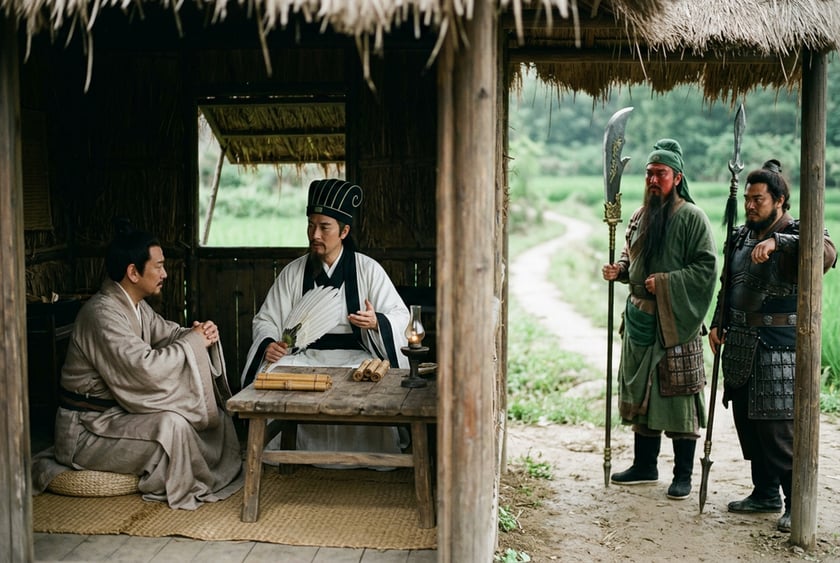
Inside a thatched cottage, Liu Bei respectfully asks Zhuge Liang about the situation across the realm. Holding a feather fan, Zhuge Liang speaks at length, while Guan Yu and Zhang Fei wait outside.
In the twelfth year of Jian'an, Liu Bei stood at the boundary between the nadir of
his political career and its turning point: dependent on Liu Biao and garrisoned at
Xinye, he was in name a kinsman of the House of Han, his good faith renowned
throughout the realm, yet he had no more than a few thousand troops and not an inch
of foundation. As he took his leave, Xu Shu recommended the "Sleeping Dragon" and
stressed that this man "can be visited but cannot be summoned by force," and that
Liu Bei must go in person to call upon him. These words elevated the
recruiting of Zhuge Liang from a single act of recruitment into a mutual test of
both sides' sincerity and standing—what Liu Bei needed was not merely an advisor but
a top-level design capable of converting his "kinsman's title" into a real-world
strategy.
Principal Figures
At the core were Liu Bei and Zhuge Liang, while Guan Yu and Zhang Fei were the
witnesses and the source of tension in this meeting. In the Romance the two were
quite contemptuous of Liu Bei's repeated visits to a villager, and Zhang Fei even
threatened to bind the man and bring him with ropes, while Liu Bei,
likening it to King Wen of Zhou calling on Jiang Ziya and Duke Huan of Qi visiting
the rustic of Dongguo five times, insisted on treating him with courtesy.
This contrast of "the lord observing the rites while his generals fail to
understand" both sets off Zhuge Liang's weight and previews Liu Bei's faction's
later style of employing men—"using human harmony to make up for deficiencies in the
timing of Heaven and the advantage of terrain."
Core Issues
The substance of the meeting was the strategic blueprint of the Longzhong Plan.
Zhuge Liang began with the four quarters of power: Cao Cao held the Son of Heaven
and commanded a host of a million and could not be contended with; Sun Quan held the
Jiangdong region through three generations, with a defensible state and a people
attached to him, and could be made an ally but not a target of conquest; Jing
Province was a land fit for waging war yet its lord could not hold it; Yi Province
was a thousand li of fertile fields yet Liu Zhang was dim and weak—the conclusion
being to straddle both Jing and Yi and guard their natural ramparts, to make peace
with the Rong tribes in the west and pacify the Yi and Yue peoples in the south, to
ally with Sun Quan abroad and put governance in order at home, and, when the realm
was thrown into upheaval, to send forth armies along two routes toward Wan and Luo
and toward the Qin plains. This was a phased strategy that ranked the weak
party's limited resources as "first seek a foothold for survival, then aim for a
tripod of three powers, and finally aim for the Central Plains"; its clear-headedness
lay in its explicit acknowledgment of the reality that Cao Cao "could not be
contended with."
Political Consequences
This meeting directly reshaped the trajectory of Liu Bei's faction. After Zhuge Liang
came out of seclusion, Liu Bei turned from a refugee warlord living under others'
roofs into a builder of a regime with a program and a sequence; the "fish and water"
metaphor established the paradigm of trust between lord and minister,
supporting the whole subsequent process of allying with Wu to resist Cao, entering
and taking Yi Province, and founding Shu Han. It can be said that the Longzhong Plan
was the political origin point of Shu Han's founding, and the pattern of the realm
divided in three had already been sketched out in advance within the thatched
cottage.
Counterfactual Speculation
The ingenuity of the Longzhong Plan also harbored a latent danger. Its conception of
"straddling both Jing and Yi and launching a two-route Northern Expedition" rested on
the premise of long-term simultaneous possession of both Jing Province and Yi
Province, together with always staying on good terms with Sun Quan; once Jing
Province was lost through the rupture of the Sun–Liu alliance, this two-route pincer
strategy lost its eastern wing, and the very root of Zhuge Liang's later repeated
sorties from Mount Qi without complete success lay precisely here. Had Liu Bei failed
to recruit Zhuge Liang and lacked this top-level design, he would very likely have
continued to waste away in dependence and wandering—but conversely, overreliance on a
single strategic blueprint also meant that once a key premise collapsed, the whole
game would be hard to rebuild. This is precisely the double-sided legacy of the Three
Visits to the Thatched Cottage, most worth pondering for later ages.