

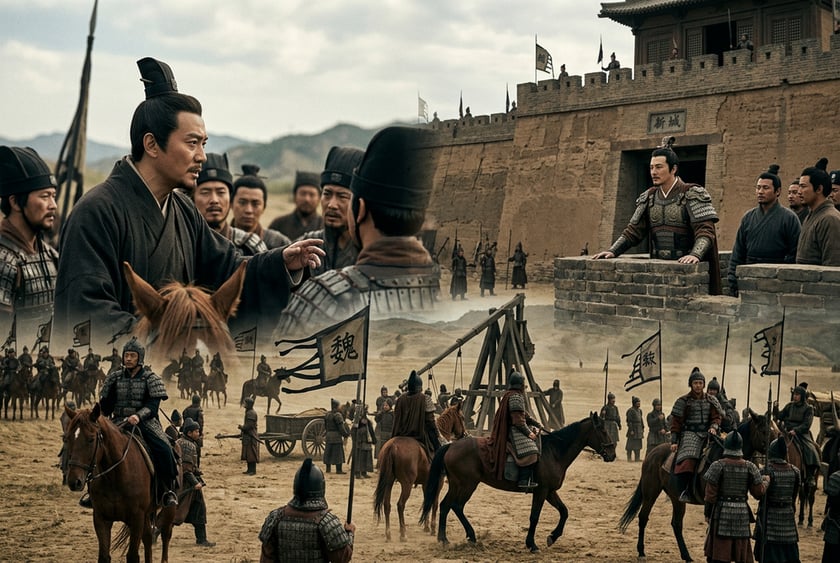

Background
Xincheng Commandery lay in the upper reaches of the Han River, adjoining Nanyang and Xiangfan to the east and Hanzhong and Bashu to the west. It sat at the junction of the Wei, Shu, and Wu spheres of influence. Meng Da had originally served under Liu Bei, but defected to Wei in 220. Cao Pi combined Fangling, Shangyong, and Xicheng into Xincheng Commandery and entrusted him with its defense, placing considerable trust in him. The novel makes this favor especially tangible: Cao Pi bestowed horses and jewels on him, traveled with him in the same carriage, and appointed him Attendant Gentleman of the Scattered Cavalry and Administrator of Xincheng, entrusting him with the southwest.
The problem arose after Cao Pi’s death. Meng Da’s protectors at the Wei court died one after another. As a former defector, and with relations strained with Shen Yi of the neighboring commandery, he became increasingly isolated. At just this moment, Zhuge Liang was preparing a northern campaign and took the initiative to correspond with Meng Da, who was also inclined to return. Structurally, this is a classic case of a frontier defector choosing sides anew after a change of power at the center: his loyalty was to an individual, not a state, and when that individual died, the basis for his allegiance wavered as well.
Forces Involved
The rebellion involved three sides. Shu Han was the instigator, hoping Meng Da would raise troops on the eastern front in coordination with Zhuge Liang’s northern campaign. In the novel, Meng Da’s plan was to muster forces from Jincheng, Xincheng, and Shangyong and march straight on Luoyang, while Zhuge Liang took Chang'an, thereby pacifying both capitals. On the Cao Wei side, Sima Yi was then in command of military affairs in Jing and Yu provinces and stationed at Wancheng, the place nearest to Xincheng and the person most familiar with Meng Da. The local powerful families, the brothers Shen Yi and Shen Dan, were the crucial third party: they had long held sway around Shangyong and were at odds with Meng Da. In the novel, they outwardly agreed to join the uprising but in fact waited for Wei forces to arrive so they could assist them from within.
Meng Da’s own camp was equally unstable. The Weilüe records that Sima Yi successfully persuaded Meng Da’s subordinate Li Fu and his nephew Deng Xian to change sides. A rebel leader unable to unite even his own relatives had already lost half the battle militarily.
The Decisive Turn
Timing decided the outcome. According to the Book of Jin, Meng Da estimated that Sima Yi would first submit a memorial for approval, and that the edict would take about a month to travel back and forth, giving him enough time to strengthen the city’s defenses. In the novel, Zhuge Liang’s reply specifically warned him that, once Sima Yi learned of the news, he would surely be the first to arrive, and urged him to make every preparation. Meng Da read the letter and laughed that Zhuge Liang was worrying too much. Sima Yi’s choice shattered that assumption: believing that waiting a month for the imperial edict to go back and forth would certainly waste time, he acted first and reported later, ordering his troops to cover in one day the distance normally covered in two, while sending an adjutant with official documents to Xincheng to keep Meng Da at ease. The Book of Jin says he reached the city walls in eight days.
This was a classic operation in which speed substituted for numbers. In a centralized military system, a regional commander who moved troops without authorization faced political risk. Sima Yi’s willingness to accept that risk shows how confident he was in his assessment of the situation, and also reflects the trust Wei Mingdi placed in him early in his reign. The novel dramatizes this turn by having Meng Da let out a long sigh when he sees the Wei army from atop the walls, admitting that Zhuge Liang had been right.
Suppression and Outcome
According to the “Annals of Mingdi” in the Records of the Three Kingdoms, in the first month of the second year of Taihe (228), Sima Yi captured Xincheng, executed Meng Da, and sent his head to the capital. The Weilüe adds that Meng Da was besieged for sixteen days, after which Li Fu and Deng Xian opened the gates and surrendered; Meng Da’s head was burned at a crossroads in Luoyang. The court then reorganized the administrative divisions, splitting up Xincheng Commandery: Shangyong, Wuling, and Wu County were made into Shangyong Commandery, while Xi County became Xi Commandery. This divide-and-rule approach reduced the likelihood of a separatist power emerging in this strategically important frontier region. The Book of Jin says that both Wu and Shu sent troops to relieve Meng Da, but Sima Yi dispatched forces to hold them off on the outskirts.
The novel’s account of the outcome is broadly consistent with the histories. It says only that Sima Yi arrived in eight days, omitting the sixteen-day siege recorded in the Weilüe, and has Meng Da quickly fall amid the fighting. It also has Zhuge Liang learn from a spy that Meng Da is dead and Sima Yi is leading his troops through the pass; this news directly leads into the episode in which Ma Su asks to defend Jieting. Another difference concerns Xu Huang: the novel says Meng Da shot him in the forehead beneath the city walls, whereas the “Biography of Xu Huang” in the Records of the Three Kingdoms records that he died in the first year of Taihe; the Records of the Three Kingdoms does not mention his participation in this campaign.
Historical Reverberations
The significance of the Xincheng Rebellion went far beyond the loss or capture of a single city. For Shu Han, the eastern-front diversion fell through, depriving Zhuge Liang’s First Northern Expedition of a flank operation. He had to fight alone in Longyou and then suffered defeat at Jieting. For Cao Wei, suppressing the rebellion was Sima Yi’s first successful independent command under Mingdi. It won him military prestige, and a few years later he was transferred to Guanzhong to oppose Zhuge Liang.
From a broader perspective, Meng Da’s defeat also points to the predicament commonly faced by defectors on the Three Kingdoms’ frontiers: they often shifted repeatedly among two or three regimes, finding it difficult both to earn the genuine trust of a new ruler and to regain the confidence of an old one. Meng Da first left Liu Zhang to join Liu Bei, then defected to Wei, and finally plotted to return to Shu. After changing sides several times, he was left no room to maneuver in the face of Sima Yi’s forced march. Had Meng Da not hesitated and risen immediately as Zhuge Liang set out from Mount Qi, he might still have been unable to hold Xincheng in the end, but he could have forced Sima Yi to divert troops eastward, potentially changing the course of the fighting in Guanzhong and Longyou.