Records
Cao forces won
Vol. 1「公圍壺關三月,拔之」
205 CE (Jian'an 10) · Huguan
In Jian’an 10–11 (205–206), after Cao Cao Pacifies Hebei, Yue Jin, Li Dian, and others attacked Bingzhou but were held up by Gao Gan, who was defending Huguan Pass. Cao Cao then led troops there. The Cao army used a feigned surrender to seize the pass. Gao Gan fled, but was later killed at Shanglu by Commandant Wang Yan, and his head was sent to Cao Cao. This campaign brought Huguan Pass under Cao army control and further consolidated Cao Cao’s rule over Bingzhou and Hebei.
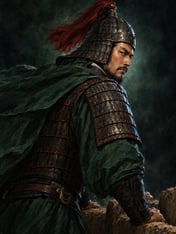 Gao GanCommanderTalk to me
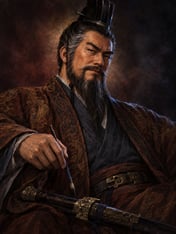 Cao CaoLivedCommanderTalk to me
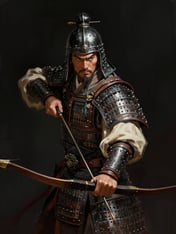 Yue JinWarriorTalk to me
 Li DianWarriorTalk to me
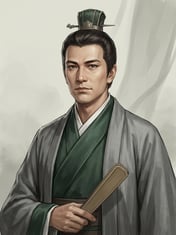 Xun YouAdvisorTalk to me
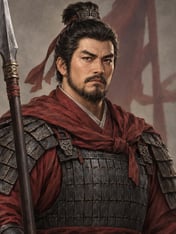 Lü KuangWarriorTalk to me
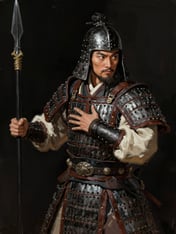 Lü XiangWarriorTalk to me
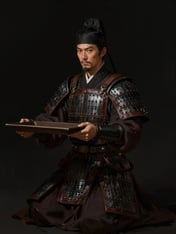 Wang YanInstigatorTalk to me
Who won, as each book tells it; commanders as the text names them.
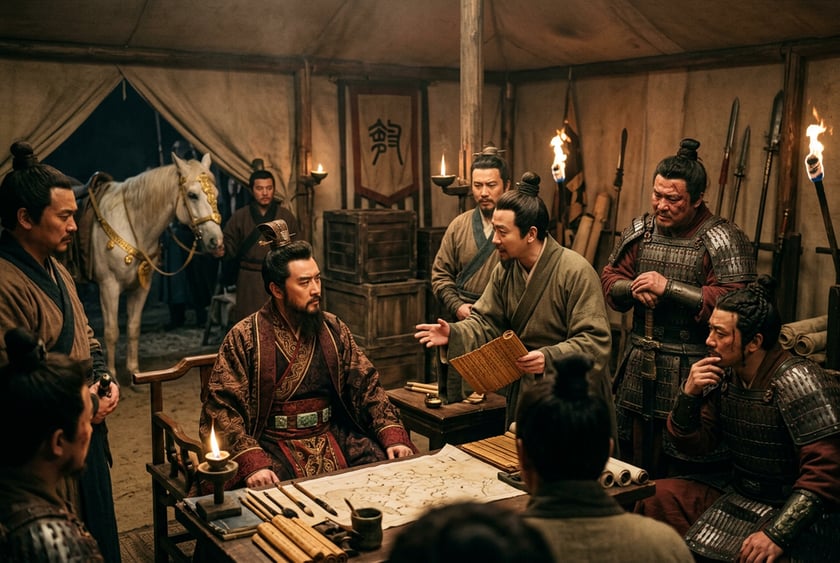
Scene
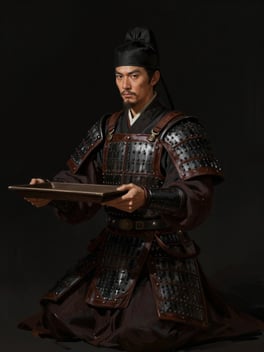
Cao Cao gathers his generals in the camp tent to hear Xun You present his plan. Holding bamboo slips, Xun You speaks confidently as candlelight flickers inside the tent.
Continue
Wang Yan, a commandant under Cao Cao, was enfeoffed for capturing and beheading the rebel Gao Gan; the novel depicts him presenting Gao Gan’s head to Cao Cao.
1894 people in common
2013 people in common
2072 people in common
2082 people in common
2012 people in common
2102 people in common
1982 people in common
1982 people in common
The Battle of Hugouguan falls within the narrative of Cao Cao Pacifies Hebei and his continued advance into Bingzhou. According to the dates specified in the prompt, the battle took place around Jian’an 10–11 (205–206), but the cited volume 33 of Romance of the Three Kingdoms gives no precise date. This should therefore be treated as chronological information attached to the battle entry, not as a date that can be independently verified from the passage itself. The text first recounts Wu Huanchu leading his followers in surrender and Cao Cao appointing him General Who Guards the North. A scout then reports that Yue Jin, Li Dian, and Zhang Yan have been held up in their attack on Bingzhou, while Gao Gan is holding Huguan Pass. This sequence marks a shift in the battlefield, from the situation in Hebei to a struggle over a strategic outpost on its frontier: a newly surrendered force has just joined Cao Cao’s ranks, yet a well-defended pass still blocks his advance.
The importance of Huguan Pass, in the materials available, lies chiefly in its role as a barrier protecting Gao Gan’s defense of Bingzhou, rather than in any detailed evidence about its terrain or transport links that would establish it as an “indispensable strategic point.” Yue Jin, Li Dian, and the others are already fighting before the pass, but cannot take it quickly because “the pass is difficult to attack while defended.” Cao Cao therefore leads troops there in person and summons his generals to discuss how to break through. The focus of the fighting, then, is not a head-on battle between large armies on open ground, but how to overcome the defensive advantage conferred by the pass. Cao Cao’s arrival also indicates that, at least in the novel’s narrative, the impasse had become a military problem requiring the commander’s personal attention.
Cao Cao’s forces combine an assault at the front, the commander’s overall direction, and a stratagem to break the deadlock. Yue Jin, Li Dian, and Zhang Yan attack the pass first, and Cao Cao arrives in person afterward. Xun You’s proposal to “use a feigned surrender” shifts the emphasis from a direct assault to luring the enemy out of the pass. The material does not explain how the would-be defector was selected, how contact was made, or what signals were used, so it does not support adding a fully developed espionage operation. But from the later account of the “two Lü” leading more than ten thousand troops out first, followed by Cao Cao’s forces lying in ambush, the stratagem’s central aim is clear: to create an opportunity for Gao Gan to attack while drawing him away from the walled pass.
Gao Gan’s forces are based on holding the pass, but they also try to break out of a defensive posture by taking the initiative. After accepting the proposal of a feigned surrender, Gao Gan orders the “two Lü” to lead more than ten thousand troops out ahead. This shows that the defenders do not intend merely to shut the gates and hold out; they are willing to commit a sizable force to pursue or receive those coming over to their side. The two Lü can be identified, according to the people named in the prompt, as Lü Kuang and Lü Xiang; however, the quoted passage calls them only “the two Lü” and does not give their full names here. Cao Cao’s forces have already laid an ambush. When the troops approach the camp, they attack from all sides, and the fighting shifts at once from luring the enemy out to striking them. Yue Jin and Li Dian then seize the pass, linking the ambush outside the walls with control of the gateway in a single chain of action.
The first key decision is Xun You’s recommendation to use a feigned surrender rather than continue the direct assault. Cao Cao’s generals had already stated that Gao Gan’s position at the pass made it difficult to attack, establishing the challenge of a frontal assault as the immediate reason for the stratagem. The military value of the feigned surrender lay in inducing the defenders to commit troops and leave their most advantageous defensive position. Its risks were also clear: if Gao Gan did not believe the ruse and refused to send out troops, Cao Cao might not get the same opportunity to lure him out; if the defenders sent only a small force or kept it closely connected to the pass, the ambush and seizure of the pass might also prove difficult. The novel gives only the outcome after the stratagem succeeds; it does not explain how these risks were assessed or managed.
The second key decision is Gao Gan’s choice to believe the ruse and send the two Lü out with more than ten thousand troops. He may have been seeking to press an advantage and destroy Cao Cao’s forces before the pass, or hoping to take the initiative; but the passage does not state his motives, so these can only be offered as an analysis of the deployment, not as established fact. For Cao Cao, the ambush’s launch as the enemy approached the camp shows that the timing of the lure and the strike aligned successfully. Yue Jin and Li Dian’s seizure of the pass then rapidly turns a local battlefield advantage into control of the stronghold. Had they merely driven back the troops that came out, Gao Gan could still have used the pass to block their advance. Seizing it is therefore the decisive tactical step in this episode.
As for the course of the battle, Romance of the Three Kingdoms recounts how Cao Cao’s forces lure out Gao Gan’s troops, defeat them in an ambush, and then have Yue Jin and Li Dian seize Huguan. Gao Gan himself escapes. The direct tactical outcome as portrayed in the novel is thus clear: Cao Cao’s forces take the pass, and Gao Gan loses his stronghold. However, the battle’s overall outcome is specified as “unknown,” and the only material available here is a passage from the novel. It cannot substitute for research into the historical outcome. The more careful formulation is: “In the novel, the struggle for Huguan ends with Cao Cao’s forces taking the pass; the outcome of the battle as a whole remains unknown according to the information specified in the prompt.”
After losing the pass, Gao Gan first tries to seek refuge with the chanyu and asks the Worthy Prince of the Left for help, but is refused. He then turns to Liu Biao, but on the way, at Shanglu, he is killed by Commandant Wang Yan. Wang Yan is enfeoffed as a marquis for delivering Gao Gan’s head. This ending shows that losing the pass not only forces a military retreat but also steadily narrows Gao Gan’s options for political support. However, the material does not say whether Wang Yan acted on Cao Cao’s orders, nor does it describe any military threat Gao Gan might have posed afterward. His death therefore cannot simply be equated with the complete stabilization of the region. For Cao Cao’s side, the capture of the pass and Gao Gan’s death together represent a further weakening, in the novel, of hostile forces along the Hebei–Bingzhou front.
If Gao Gan had seen through the feigned surrender, or had sent only a small force to reconnoiter instead of leading more than ten thousand troops out, the ambush might have yielded far less, leaving the assault on the pass as the main challenge. Cao Cao might then have needed to continue the siege, find a route around the pass through different terrain, or try to cut off communications between the inside and outside. But these are only conditional scenarios based on the difficulty of attacking a defended pass and the design of the feigned-surrender stratagem; the cited passage does not say what fallback plans Cao Cao’s forces had prepared. Conversely, Gao Gan might have preserved the barrier by staying within the pass rather than seeking a single decisive sortie, though that would not necessarily have reversed the pressure from Cao Cao’s forces. The fighting might have dragged on rather than ending immediately.
If Cao Cao’s forces had succeeded in luring out the defenders but failed to seize the pass in time, the advantage gained from the ambush might not have developed into a breakthrough in the campaign. Gao Gan might have regrouped the surviving troops, fallen back into the pass, and continued to rely on its defenses. Yue Jin and Li Dian’s seizure of the pass is thus an essential second phase of the stratagem, not an automatic consequence of the ambush. If Gao Gan had received help from the Worthy Prince of the Left, his escape route and capacity to fight again might have improved; however, the novel explicitly says that the prince refused to intervene, so outside aid cannot be treated as an actual factor in the battle. Overall, the lesson presented by this fighting is not that “feigned surrender always succeeds,” but that luring the enemy out, ambushing them, and capturing a key stronghold must be closely coordinated. Since the only source for the battle is volume 33 of Romance of the Three Kingdoms, caution is still warranted regarding the forces involved, the course of the historical battle, and its final outcome.