Eastern Wu · General
Liu Zan
183–255
Not to be confused with Liu Zan (刘瓒) — Liu Zan was a son of Shu Han’s Later Lord Liu Shan and was made Prince of Xinping in Yanxi 19.
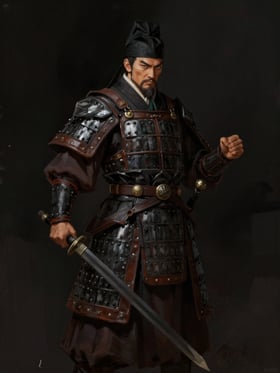
Liu Zan was a general of Wu who served as General of the Left; in the Battle of Dongxing he greatly routed the Wei army as the vanguard. Together with Ding Feng and others he resisted Zhuge Dan in Shanxi.

Life
In the Records: 5 volumes
Life183–255
252 CE (Jiaping 4)
- Battle of DongxingDongxingWarrior
255 CE (Zhengyuan 2)
- Sun Jun's Attack on ShouchunShouchunKilled in action
- Wen Qin Flees from Huainan to WuTuogaoKilled in action
Appearances
By chapter (5)
Records
- 4
- 28
- 48
- 55
- 64
- Eastern Wu· Undated
- Life event
- Death
List all 4 stops
On the boards
Compare with someone →Where this person ranks on each board.
Who they were
Character profile
- Character
- Liu Zan was a general of Wu who served as General of the Left; in the Battle of Dongxing he greatly routed the Wei army as the vanguard. Together with Ding Feng and others he resisted Zhuge Dan in Shanxi.
- Life
- Liu Zan died in battle at Gubei in the second year of Wufeng.
- Anecdotes
- Liu Zan was cut down by Zhuge Dan in the second year of Zhengyuan, and was afterward pursued and beheaded by Jiang Ban.
Historical Record
Liu Zan, courtesy name Zhengming, was from Changshan in Kuaiji. In his youth, he served as a local clerk and fought the Yellow Turban rebel leader Wu Huan. He personally killed Wu Huan, but was wounded in one leg and left with a disability that made it impossible to straighten. Fierce by nature, he enjoyed reading military texts and the Three Histories, and often studied the strategies of accomplished generals of antiquity. Unwilling to remain confined to his home village, he cut the tendons in his leg himself and endured excruciating pain as it was pulled straight. After the wound healed, he could still only walk with a limp, but he was appointed to office nonetheless. Ling Tong heard of his story, received him, and recommended him to Sun Quan. Liu Zan gradually accumulated military merit and rose to become Colonel of the Garrison Cavalry. He spoke frankly in remonstrance and refused to curry favor, which made Sun Quan wary of him.
Liu Zan later joined Zhuge Ke in the Battle of Dongxing, serving as a vanguard and charging first into the enemy ranks. He inflicted a major defeat on the Wei army and was promoted to General of the Left. In the second year of Wufeng (256), Sun Jun campaigned in Huainan, giving Liu Zan a tally of authority and appointing him Protector of the Left to lead troops in an attack on Shouchun. At the time, the Wei generals Guanqiu Jian and Wen Qin had rebelled. On hearing the news, Sun Jun and the others sent out troops. Wen Qin later surrendered, and the Eastern Wu army turned back. Liu Zan’s illness worsened on the way, and Sun Jun ordered him to return ahead with the supply wagons. But the Wei general Jiang Ban pursued him with four thousand infantry and cavalry. Gravely ill, Liu Zan was unable to organize his battle formation. Knowing victory was unlikely, he removed his curved canopy and seal of office and handed them to his disciple, urging him to leave and saying that dying together would serve the state no purpose. Jiang Ban ultimately defeated and killed him. Liu Zan was seventy-three. Wei accounts say he was pursued and killed by Jiang Ban, a subordinate of Zhuge Dan, while Eastern Wu accounts record that he was killed after being defeated. Both accounts place the event after the fighting at Shouchun, amid the defeat near Gupi.
In the Novel
The available sources provide no episodes involving Liu Zan in Romance of the Three Kingdoms or other novels, so they offer no basis for depicting him as a literary character; he does not appear in the novel. The accounts here of his treating his injured leg, charging into battle at Dongxing, and bringing up the rear while ill all come from the Records of the Three Kingdoms and materials preserved in Pei Songzhi’s annotations. They should not be recast as episodes from a novel.
Key Relationships
Liu Zan’s relationship with the Eastern Wu regime involved both service as a military officer and a willingness to speak frankly in remonstrance. He received his first appointment through Ling Tong’s recommendation and later rose through military merit; Sun Quan, in turn, was wary of him because he spoke plainly and would not flatter him. In the Battle of Dongxing, Liu Zan served as the vanguard under Zhuge Ke’s command and joined Lü Ju, Tang Zi, Ding Feng, and others in repelling the Wei army. According to the historical record, the Wei army was driven back, and Liu Zan was promoted to General of the Left.
The defeat at Shouchun entangled his fortunes with those of Sun Jun, Wen Qin, and the Wei general Jiang Ban. Sun Jun led Lü Ju and Liu Zan in an attack on Shouchun as the situation shifted following Wen Qin’s rebellion against Wei. Wen Qin surrendered to Sun Jun, and the Eastern Wu army withdrew. Ill with sickness, Liu Zan went ahead with the baggage wagons and was pursued by Jiang Ban. When defeated, he gave his disciple the chance to escape, but could not get away himself—a sign that even in crisis he remained mindful of the army and the state.
Defining Scenes
The most striking turning point in Liu Zan’s life began with what he did about his injured leg. After an early battle left his leg bent and unable to straighten, he refused to spend the rest of his life confined to his home village. He cut the tendons in his leg himself, then had his family pull it straight. Even after the wound healed, he still walked with a limp, but he was appointed to office again. This episode links his fierce character and determination to serve with his later years of military service.
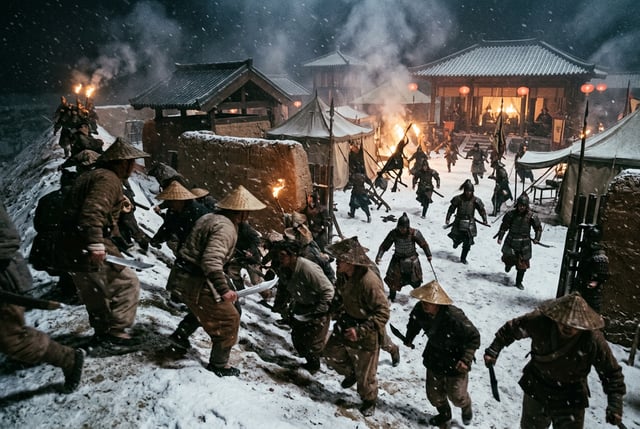
The Battle of Dongxing showed his ferocity as a vanguard. When the Wei army attacked the fortified camps on both sides of the Dongxing embankment, Zhuge Ke assigned Liu Zan, Lü Ju, Tang Zi, and Ding Feng to the vanguard. It was cold and snowing, and the Wei officers were feasting. Seeing that the Wu army was small and its armor in disarray, they failed to take precautions in time. The Wu troops climbed the embankment, beat their drums, and attacked; the Wei army panicked and fled. A biography preserved in Pei Songzhi’s annotations also says that whenever Liu Zan faced the enemy, he would let his hair down, call to the heavens, and sing loudly; only after those around him joined in would he go into battle. It also says that he never lost a battle. This habitual ritual, together with his achievements as the first to reach the enemy at Dongxing, shaped his image as a valiant general.
His final battle stands in contrast to his earlier struggle to return to the field: once, he endured pain to regain the chance to serve, but in old age illness left him unable to form ranks. As Jiang Ban’s pursuers closed in, Liu Zan removed his curved canopy, handed over his seal of office, and urged his disciple to hurry away, saying that if they both died, it would only delight the enemy. He himself was ultimately killed. The sources also record the sorrow people felt at his death, making this defeat not merely the end of a campaign, but the final chapter of an old general who placed his duty above his own life.
Family, lords and rivals
1 relationships

Who is Liu Zan connected to?
Pick someone to see how many steps lie between them and Liu Zan.
Combat
On the field
Duels, kills and executions as the texts tell them, counted separately for the Records and the Romance.
- RecordsJuan 4Struck downZhuge DanLost「諸葛誕拒擊破之,斬吳左將軍留贊」
Events
Events (3)
Battles and events the texts place this person in, by date.
Battles
- 252Battle of DongxingWarrior
Other events
- 255Sun Jun's Attack on ShouchunKilled in action
- 255Wen Qin Flees from Huainan to WuKilled in action
Places
- Native of
- KuaijiRecords
Continue
Battle of Dongxing
Inner monologues · AI-generated1 monologue ▸
- I was originally a Wu general. After the embankment at Dongxing was rebuilt, two forts were established, each garrisoned