Sun Quan's Faction · Grand Marshal of the Left
Shi Ji
courtesy name 公绪 · also called 朱绩 · –270
Not to be confused with Shi Ji (史迹) — Shi Ji was a subordinate of the Eastern Wu general Pan Zhang. In the novel, Huang Zhong killed him in fewer than three bouts.
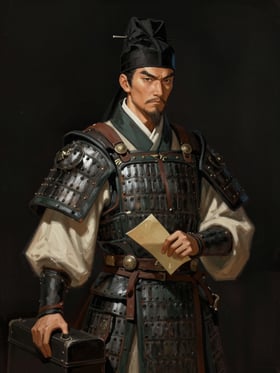
Wu general Shi Ji was known for pursuing Wang Chang at Jinan and secretly writing to ally with Shu under Sun Chen’s rule.
Life
In the Records: 4 volumes
Life?–270
Appearances
By chapter (4)
Records
- 27
- 48
- 56
- 58
- Sun Quan's Faction· Undated
- Shu Han· Undated
On the boards
Compare with someone →Where this person ranks on each board.
Historical Record
Shi Ji, courtesy name Gongxu, was appointed a Gentleman in his early years through his father’s influence, and later was appointed Commandant of Jianzhong. After his uncle Zhu Cai died, he took over Zhu Cai’s troops and followed Grand Administrator Pan Jun in campaigning against Wuxi, earning a reputation for courage and resolve. He subsequently held the posts of General of the Separate Cavalry and Supervisor of the Camp, while also overseeing matters involving bandits; he enforced the law impartially. Sun Ba, Prince of Lu and a son of Sun Quan, once visited Shi Ji’s office, hoping to befriend him. Shi Ji, however, rose to his feet and politely declined, refusing the overture. After Zhu Ran died, Shi Ji carried on his work and was appointed General Who Pacifies Wei and Supervisor of Lexiang.
The Wei general Wang Chang attacked Jiangling but failed to capture it and withdrew. Shi Ji advocated pursuing him and wrote to General Who Inspires Might Zhuge Rong, inviting him to attack from front and rear. Zhuge Rong agreed, and Shi Ji led his troops to catch up with Wang Chang at Jinan. He won the initial engagement, but Zhuge Rong did not advance, and Shi Ji was subsequently defeated. Sun Quan praised Shi Ji and angrily rebuked Zhuge Rong, deepening the estrangement between the two men. In the first year of Jianxing, Shi Ji was promoted to General Who Guards the East.
In the second year of Jianxing, Zhuge Ke attacked Xincheng and called on Shi Ji to join forces, but left him at Banzhou and appointed Zhuge Rong to take over his duties as well. In winter, Zhuge Ke and Zhuge Rong were killed, and Shi Ji returned to Lexiang, where he was granted imperial authority to act independently. In the second year of Taiping, he was appointed General of Agile Cavalry. While Sun Chen held power and court officials were apprehensive, Shi Ji feared that turmoil in Wu would give Wei an opportunity to exploit the situation. He secretly wrote to Shu Han, prompting the Shu side to prepare for the possibility of an invasion. Shu sent Yan Yu with five thousand troops to reinforce the defense of Baidi, where they awaited further news from Shi Ji. Early in the Yong’an era, Shi Ji was promoted to Senior General-in-Chief and Chief Supervisor of the Protectorate, responsible for the area from Baqiu to Xiling. In the first year of Yuanxing, he became Left Grand Marshal. During the Wufeng era, he submitted a memorial requesting permission to restore the surname Shi, and his request was approved. He died in the second year of Jianheng.
The Records of the Three Kingdoms also records that when Shu was attacked by Wei forces, Wu sent Liu Ping to Nan Commandery to discuss the direction of the campaign with Shi Ji. Ding Feng and others dispatched forces separately to relieve Shu; only when news arrived that Liu Shan had surrendered to Wei did the Wu army halt its operations.
In the Novel
The novel does not portray this figure. The surviving material provides no account of how the novel characterizes Shi Ji, so no words, actions, or military exploits in the novel can be attributed to him; the following account of his life and career is based entirely on the Records of the Three Kingdoms.
Key Relationships
Shi Ji’s relationship with Zhu Ran involved both family succession and a change of surname: as Zhu Ran’s son, he benefited from his father’s standing to be appointed a Gentleman, and after Zhu Ran’s death he carried on his father’s work. During the Wufeng era, he submitted a memorial to restore the surname Shi. The sources record that after his uncle Zhu Cai died, he took over his uncle’s troops.
Shi Ji had different kinds of dealings with Sun Ba, Zhuge Ke, and Zhuge Rong. Sun Ba took the initiative to show goodwill, but Shi Ji refused to befriend him. Shi Ji was already on poor terms with Zhuge Ke and Zhuge Rong; during the pursuit of Wang Chang at Jinan, he was defeated when Zhuge Rong failed to advance as agreed, further deepening their estrangement. Zhuge Ke later called on him to join the attack on Xincheng, but left him at Banzhou.
As for Wu-Shu relations, Shi Ji was not, according to the sources, someone who defected to Shu Han. Rather, while Sun Chen held power, he secretly sent a letter to Shu, intending to guard against turmoil in Wu and the possibility that Wei might exploit it. Shu reinforced the defense of Baidi and awaited further news from him.
Defining Scenes
Shi Ji’s refusal of Sun Ba’s overture illustrates his cautious approach to dealing with others. Sun Ba came in person to his office, hoping to establish friendly relations, but Shi Ji refused to associate with him. The Records of the Three Kingdoms presents his stance through a brief description of his actions, without explaining the specific reason for his refusal.
The pursuit at Jinan reveals Shi Ji’s aggressiveness, as well as the constraints he faced on the battlefield. After Wang Chang withdrew, Shi Ji judged that the enemy was exhausted and invited Zhuge Rong to attack from front and rear. Shi Ji engaged first and won, but was defeated when the promised support failed to materialize. After this battle, Sun Quan praised Shi Ji and angrily rebuked Zhuge Rong, further worsening the existing discord between them.
Another key scene took place when Wu’s political situation was unstable. Shi Ji feared that Sun Chen’s hold on power could provoke internal unrest and that Wei might take advantage of the situation to advance. He therefore contacted Shu Han in secret. Shu sent troops to reinforce the defense of Baidi, showing that the secret letter led to concrete military preparations, though the sources do not record the specific content of the “further orders” Shi Ji later sent.
Lines
- 史 ch.56 §22→ Zhuge Rong
「昶遠來疲睏,馬無所食,力屈而走,此天助也。今追之力少,可引兵相繼,吾欲破之於前,足下乘之於後,豈一人之功哉,宜同斷金之義。」
- Family
- Lord & vassal
- Enemies
- Other
Who is Shi Ji connected to?
Pick someone to see how many steps lie between them and Shi Ji.
Places
- Was at
- Nan CommanderyRecords

Continue
Zhu Ran
Parent
Relationship timeline3 entries ▸
History · vol. 56
- Pan Jun§21
Fights
After his uncle Zhu Cai died, took command of his troops and joined Grand Master of Ceremonies Pan Jun in campaigning against Wuxi
- Wang Chang§22
Fights
Wang Chang attacked Jiangling but failed to take it and withdrew; Shi Ji wrote to Zhuge Rong proposing that they pursue together; when they reached Jinan, Ji won the first engagement but Rong did not advance, and Ji later suffered a defeat
- Zhuge Rong§22
Rival
Wrote to Zhuge Rong, agreeing to pursue Wang Chang; Rong replied in assent but did not advance; was initially at odds with Ke and Rong, and this became worse after the incident