Overview
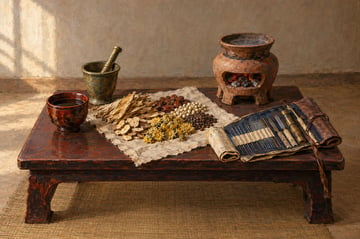
The Green Bag Book is a book in Hua Tuo’s possession through which his medical knowledge can be passed on. Its title appears only in Romance of the Three Kingdoms, where chapter 78 calls it the Green Bag Book; Records of the Three Kingdoms describes the book Hua Tuo produced before his death simply as “a scroll,” without giving a title. Later generations also commonly called it “Qingnang jing” (青囊经), a form used in neither work.
Origins
In Romance of the Three Kingdoms, the book is originally kept at Hua Tuo’s home. While Hua Tuo is imprisoned, a jailer, Wu Yayu, brings him wine and food every day. Grateful for his kindness, Hua Tuo writes a letter and asks Wu Yayu to send someone to his home to fetch the Green Bag Book, which he wishes to give him so that his medical arts may be carried on. Wu Yayu takes Hua Tuo’s letter straight to Jincheng and obtains the book from Hua Tuo’s wife.
Provenance
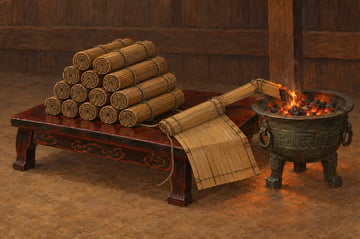
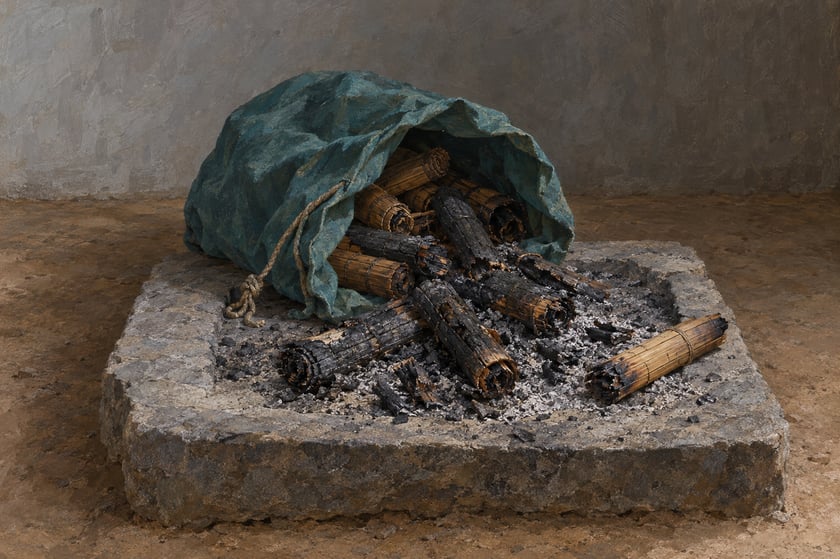
Records of the Three Kingdoms relates that Cao Cao (called “Taizu” here) had Hua Tuo sent to prison in Xuchang (written here as “Xu” [许]) for interrogation and ultimately had him killed; these events are covered in Cao Cao Has Hua Tuo Executed and The Death of Hua Tuo. Before his death, Hua Tuo took out a scroll and offered it to a jailer, saying, “This can save lives”. The jailer feared the law and dared not accept it. Hua Tuo did not insist, but asked for a fire and burned the book.
In Romance of the Three Kingdoms, Wu Yayu brings the book back to the prison and hands it to Hua Tuo. After examining it, Hua Tuo gives it to Wu Yayu, who takes it home for safekeeping. Ten days later, Hua Tuo dies in prison. Wu Yayu resigns his post and returns home, intending to study the book, only to find his wife burning it. He hurriedly snatches at it, but the entire scroll has been destroyed except for one or two pages. His wife says that even if he acquires skills as wondrous as Hua Tuo’s, he will only end up dying in prison, so what use is the book? The novel says that the book is therefore never handed down; all that survives is the minor techniques, such as castrating chickens and pigs, recorded on the one or two remaining pages.
Notable Episodes
A poem by a later writer included in this chapter of Romance of the Three Kingdoms refers to the book as “Qingnang” (青囊), lamenting the loss of both the man and his book: “Alas, the man is gone and the book too is lost; later generations will never again see Qingnang”.
History and the Romance
Title: The book’s title appears only in Romance of the Three Kingdoms; the scroll described in Records of the Three Kingdoms is unnamed.
Receiving and burning the book: In Records of the Three Kingdoms, the jailer feared the law and refused the book, and Hua Tuo himself burned it; in the Romance, Wu Yayu accepts the book and keeps it, and his wife burns it, leaving only one or two pages.
Scholarship
According to later scholarship, both Hou Hanshu and Records of the Three Kingdoms relate that, before his death, Hua Tuo offered a medical book to a jailer and burned it when the jailer refused it. Neither work gives the book’s title.