





Background
The Danyang Incident is dated to the ninth year of Jian’an (204), but the material cited here comes from volume 38 of Romance of the Three Kingdoms, rather than from multiple historical sources that could corroborate the details of the event. The following analysis should therefore treat the full account of “Sun Yi’s murder and Xu Shi’s revenge” as a political case within the novel’s narrative, not as an unqualified historical fact; under the terms of the question, the actual outcome remains unknown. The volume places the crisis during Sun Yi’s tenure as Administrator of Danyang. Its causes intertwine his personal style of governance, his subordinates’ resentment, and local power struggles: Sun Yi is described as hot-tempered and fond of drink, and as flogging soldiers when drunk; the supervisory officers Gui Lan and Dai Yuan, meanwhile, are portrayed as having long harbored murderous intentions and as enlisting Sun Yi’s attendant Bian Hong in their plot.
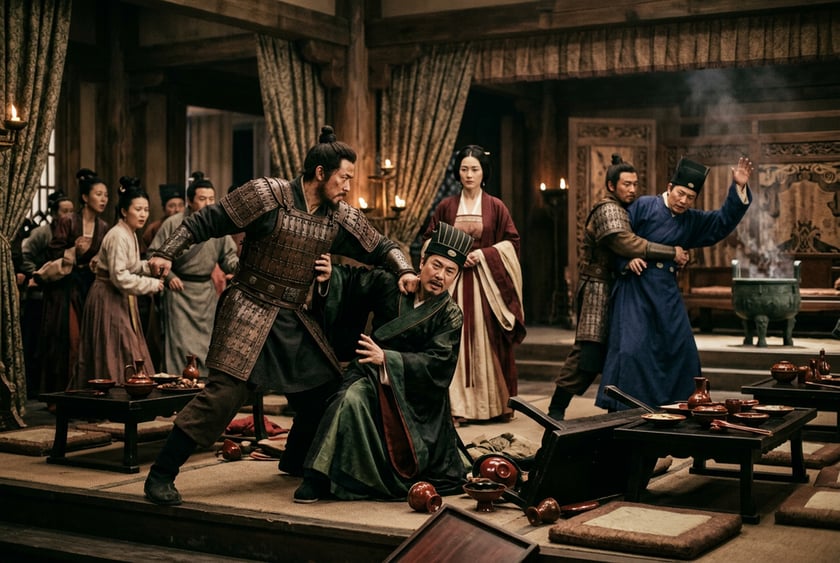
The novel’s opening is not an open rebellion but a banquet. The officers and county magistrates gather in Danyang, and Sun Yi hosts a feast for them. After divining the signs, Xu Shi believes danger is imminent and urges him not to attend, but Sun Yi ignores her advice. After the banquet breaks up, Bian Hong waits outside the gate with a knife and kills Sun Yi. Gui Lan and Dai Yuan immediately shift the blame onto Bian Hong and have him executed. This arrangement links a court-style assassination with the dissociation of responsibility: the actual killer is eliminated, while the masterminds try to disguise their private coup as an isolated murder by controlling information, the scene, and subsequent appointments.
Main Figures
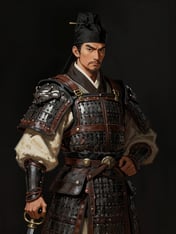
In the narrative, Sun Yi is both the victim and part of the governing context in which the crisis takes shape. His methods of punishing subordinates make the power relationship one of personal intimidation, yet he fails to turn that authority into reliable protection. The novel does not explain whether his harshness was enough to account for his subordinates’ conspiracy to murder him, nor does this justify blaming the victim for the violence. More significant is that the Administrator’s attendants, supervisory officers, and commandery assistant could form a lethal alliance, showing that office and personal proximity alone were not enough to ensure loyalty.
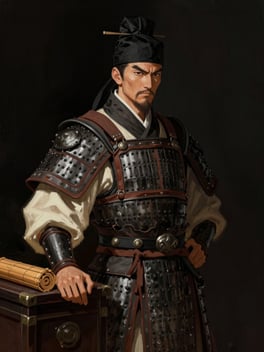
Gui Lan and Dai Yuan are portrayed as prominent figures in the local military and administrative systems. After conspiring together, they also try to seize Sun Yi’s property and concubines, revealing that the coup involved not only replacing a leader but also redistributing wealth, control over family members, and power. Bian Hong is the direct perpetrator, but also the scapegoat who is swiftly put to death. In this passage, Sun Quan figures chiefly as an external authority and the one who handles matters afterward: Xu Shi secretly sends someone to inform him; he does not intervene directly at the scene of the murder.
Xu Shi’s role goes beyond the traditional narrative position of a bereaved woman simply waiting to be rescued. She buys time by claiming that she needs to postpone remarriage, secretly contacts Sun Gao and Fu Ying, and then uses the arrangements for a memorial rite and the ending of mourning to lure Gui Lan to a banquet. Sun Gao and Fu Ying, in turn, take up the counterattack on the grounds of the favor Sun Yi had shown them in the past. Her actions combine the transmission of intelligence, psychological misdirection, and the deployment of force, showing that responding to a crisis takes more than declarations of loyalty: private spaces must be turned into sites of organized action. This characterization, however, also bears the literary imprint of a novel that shapes its exemplary figures through courage, resourcefulness, and moral integrity.
Central Issues
The first issue is the principal-agent problem in local governance. An Administrator depends on supervisory officers, a commandery assistant, and personal attendants to maintain local order, but those who control force and day-to-day administration may also become the threats closest to the center of power. After Sun Yi is murdered, Gui Lan and Dai Yuan are able to deal swiftly with Bian Hong, take control of the household’s property, and coerce Xu Shi. This shows that the crisis depicted in the novel is “endogenous”: the regime is not broken by a distant enemy army but seized from within its own governing network. The text says nothing about formal oversight or succession procedures, so security depends largely on personal relationships and retaliation after the fact.
The second issue is the contest between legitimacy and violence. Gui Lan and Dai Yuan gain de facto control by killing, but establish neither public authorization nor stable order. Xu Shi and the former officers, by contrast, draw on Sun Yi’s surviving family, past bonds of favor, and their appeal to Sun Quan in an effort to place their actions under a higher political authority. Here, “loyalty and righteousness” serve both as moral language and as organizational resources: they frame private revenge as an effort to restore order. But the novel quickly assigns post-victory legitimacy to Sun Quan’s arrangements for appointments and garrisoning, suggesting that military success still requires recognition from above before it can become governing authority.
The third issue is the intersection of gender, property, and political control. Gui Lan’s attempt to force Xu Shi to remarry shows how coercion of a widow is folded into the victors’ appropriation of the victim’s household. Xu Shi, meanwhile, uses the promise of marriage to buy time and turn a position of passivity into an opportunity for counteraction. Her strategy demonstrates agency, but this does not mean that structural coercion disappears: the story still measures her worth through chastity, resourcefulness, and revenge. A modern reading of political history should recognize both her capacity to act and the narrative’s prescriptive idealization of women’s virtue, without mistaking the latter for a complete record of actual social conditions.
Political Consequences
According to the novel, Fu Ying first fells Gui Lan with a blow of his sword, and Sun Gao then kills him; Dai Yuan is subsequently killed at Xu Shi’s residence. Xu Shi also orders the execution of the families and remaining followers of the two men. When Sun Quan arrives in Danyang, he appoints Sun Gao and Fu Ying as gate commanders and orders them to defend the city, then brings Xu Shi back to care for her. The result is not simply a conclusion of private revenge but a reconstruction after the fact: the core of the rebellion is eliminated, new local defenders are appointed, and a higher authority confirms the new order.
Yet this conclusion also reveals the costs and limits of restoring order. In the novel, the collective punishment of the conspirators’ families and remaining followers is incorporated into the revenge narrative. From the perspective of modern political analysis, however, it could also prolong the cycle of violence and blur the boundary between individual and kin responsibility. Sun Gao and Fu Ying receive appointments, showing how loyalty is institutionalized as a reward after the crisis. But the material does not say how Danyang was governed afterward or whether the transfer of power remained stable, nor does it provide sources that independently verify these details. The appointments and resolution described in the novel therefore cannot be treated as a historically confirmed outcome.
Counterfactual Scenarios
If Sun Yi had followed Xu Shi’s advice and not attended the banquet, the most immediate change might have been that Bian Hong lost his opportunity to attack that night; this would not mean that Gui Lan and Dai Yuan’s plot automatically disappeared. Since the text says the two “had long harbored the intention to kill Yi,” postponing the crisis might simply have given both sides more time to choose other methods. If Sun Yi had earlier established more credible procedures for lodging military grievances, rotating guards, or cross-monitoring key officials, the cost of internal conspiracy might have risen. These institutions, however, do not appear in the material, so this can only be offered as a comparative speculation, not as a plan that actually existed at the time.
If Xu Shi had neither postponed remarriage nor contacted Sun Gao and Fu Ying, Gui Lan might have gained even greater control over Sun Yi’s family, property, and local military force. If Sun Quan had not received the secret report in time, local resistance might also have lacked external authorization and support. Conversely, had Sun Quan intervened earlier, he might have limited Xu Shi and the former officers’ opportunity to kill their enemies themselves and punish the remaining followers. But the material is insufficient to determine Sun Quan’s distance, forces, or intelligence conditions at the time. All these branches can only highlight the vulnerable points emphasized by the narrative—the flow of information, protection, networks of loyalty, and intervention from above—and cannot substitute for historical source criticism about the actual outcome. The real outcome of the Danyang Incident should still be marked as unknown.