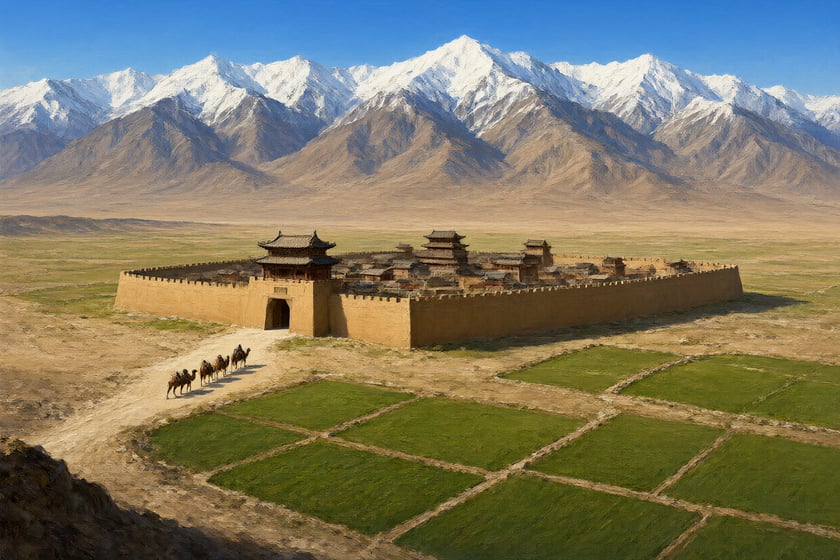
Overview
Wuwei Commandery was one of the four Hexi commanderies of Liang Province in the Han dynasty. Its administrative seat was Guzang, in present-day Liangzhou District, Wuwei, Gansu Province, at the eastern end of the Hexi Corridor. During Cao Wei, Zhang Ji, Inspector of Yong Province, wrote that Wuwei lay at the strategic choke point on the roads linking the Hexi commanderies and was also an area where Han Chinese lived alongside the Qiang and Hu peoples, making it repeatedly vulnerable to military upheaval. During the late Han and Three Kingdoms periods, the region saw a succession of events, including a commandery administrator killing an inspector, powerful local clans occupying the commandery and declaring themselves independent, and incursions by Hu peoples. It became largely peaceful only after Zhang Ji and Su Ze pacified Hexi in the early years of Cao Wei.
History
In the early Jian’an era, the four Hexi commanderies petitioned to establish a separate province, as they were too far from the seat of Liang Province and cut off by troops in revolt around the Yellow River. The court therefore appointed Handan Shang Inspector of Yong Province, placing the four commanderies under his separate jurisdiction. Because Zhang Huan had once been renowned in Hexi, his son Zhang Meng was appointed Wuwei Administrator. Zhang Meng and Handan Shang were the same age and often teased each other, but after taking office they grew suspicious of one another. Handan Shang plotted to kill Zhang Meng, who struck first, attacked him with troops, and had him imprisoned. In 209, the fourteenth year of Jian’an, Handan Shang attempted to escape and was killed by Zhang Meng. In 210, the fifteenth year of Jian’an, Han Sui led an army against Zhang Meng. The officials and people of Wuwei feared Han Sui and instead besieged Zhang Meng, who climbed a tower and burned himself to death.
Thereafter, Yan Jun of Wuwei (given as Yan Juan in the Records of the Three Kingdoms), He Luan of Zhangye, Huang Hua of Jiuquan, and Qu Yan of Xiping each occupied their own commanderies in revolt, called themselves generals, and fought among themselves. Yan Jun sent his mother and son to Cao Cao as hostages and sought aid. Zhang Ji advised Cao Cao to let them fight one another and reap the benefits. More than a year later, He Luan killed Yan Jun, and Wang Mi, a man of Wuwei, in turn killed He Luan.
At the time, there was no Liang Province, and the lands from the Three Fu region to the Western Regions all fell under Yong Province. Liang Province was reestablished only after Cao Pi assumed the title of King of Wei. Zhang Jin of Zhangye, Huang Hua of Jiuquan, and others took up arms against the newly appointed inspector. Three groups of Hu people in Wuwei also seized the opportunity to raid, cutting off the roads. Wuwei Administrator Guanqiu Xing urgently appealed to Su Ze, Administrator of Jincheng. Su Ze sent troops to relieve Wuwei, persuaded the three Hu groups to surrender, and then joined Guanqiu Xing in attacking Zhang Jin. Before long, the Lushui Hu Yijian Jiqie, Zhi Yuanduo, and others rebelled, throwing Hexi into turmoil. Zhang Ji was appointed Inspector of Liang Province. He announced that he would advance from Zhanyin, but secretly went by way of Qieci straight to Wuwei. The Hu people thought his forces were an army sent by the gods and withdrew to Xianmei, where Zhang Ji then ambushed and soundly defeated them.
During the reign of Emperor Ming of Wei, Xu Miao repaired the salt ponds of Wuwei and Jiuquan, trading salt for grain from the Hu people. He also greatly expanded the irrigated fields and recruited poor people to farm them, bringing prosperity to every household. In 247, the eighth year of Zhengshi, the Hu leader of Liang Province, Zhi Wudai, rose in response to the various Qiang tribes. The following year, he besieged Wuwei. Guo Huai advanced to Xihai and attacked his family, forcing Zhi Wudai to turn back to their aid. Guo Huai drove him off north of Longyi.
Notable Figures
- Jia Xu: A native of Guzang in Wuwei. He was obscure in his youth, and only Yan Zhong of Hanyang believed he possessed the extraordinary talents of Zhang Liang and Chen Ping.
- Zhang Xiu: A native of Zuli in Wuwei and a kinsman of Zhang Ji. As a young man, he served as a county clerk and once killed Qu Sheng, who had attacked and killed the county magistrate. He later inherited Zhang Ji’s troops and garrisoned them at Wancheng.
- Zhou Bi: A native of Wuwei who served as a Minister during Dong Zhuo’s time. Along with Wu Qiong, he recommended Han Fu and others for provincial and commandery posts. Dong Zhuo later executed him on charges of treason.
- Zhang Meng: A native of Dunhuang and son of Zhang Huan. He served as Wuwei Administrator during the Jian’an era. After killing Inspector Handan Shang, he was attacked by Han Sui and burned himself to death.
- Guanqiu Xing: Father of Guanqiu Jian. He served as Wuwei Administrator during the Huangchu era, pacified the officials and people, and won over the Qiang and Hu peoples. For his service in campaigns against Zhang Jin and the rebel Hu, he was enfeoffed as Marquis of Gaoyang Township.
Today
The former site of Guzang, the administrative seat of Wuwei Commandery, is in present-day Liangzhou District, Wuwei, Gansu Province. The Leitai Han Tomb north of Wuwei city is a late Eastern Han tomb. The bronze galloping horse unearthed there, known as “Horse Treading on a Flying Swallow,” is a symbol of Chinese tourism.