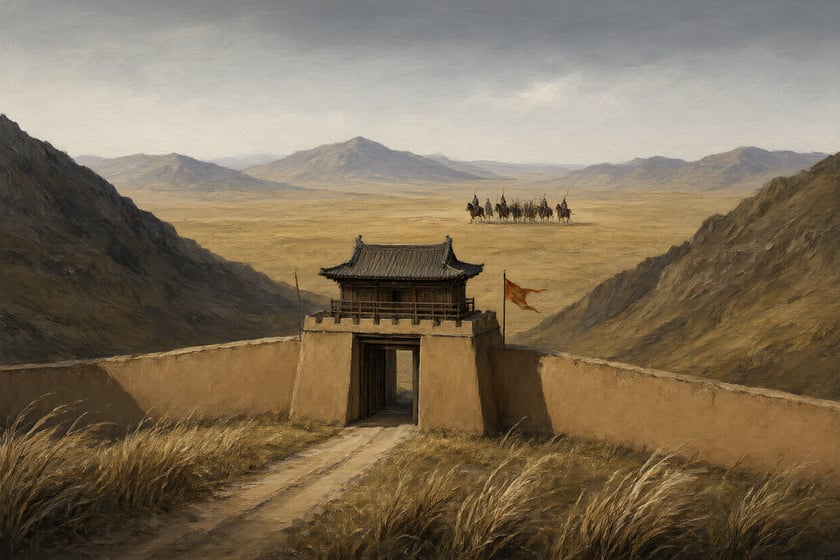
Overview
Yanmen Commandery was a frontier commandery established during the Qin dynasty. Under the Eastern Han, it belonged to Bingzhou, and its seat was at Yinguan. During Cao Wei, the commandery seat was moved to Guangwu. Its territory covered roughly the area of present-day Shuozhou, Xinzhou, and Datong in northern Shanxi Province, with Mayi as one of its subordinate counties. Located on the northern frontier, Yanmen had long been interspersed with the Wuhuan and Xianbei peoples since the Eastern Han.
History
In the twenty-fifth year of Jianwu in the Eastern Han (49), the Wuhuan leader Hao Dan and others led their people in submitting to the Han, and they were settled in Yanmen and other frontier commanderies. In the sixth year of Xiping (177), Zang Min, Colonel Director of the Huns, and the Southern Chanyu led a campaign against the Xianbei beyond the Yanmen Pass. They were defeated by Tanshihuai, and only one in ten of their troops survived.
During Emperor Wen of Wei’s reign, Qian Zhao was appointed Administrator of Yanmen. He trained the people in battle formations, sowed discord among the Xianbei tribes, repaired the old city of Shangguan north of Xing, and established garrisons, bringing banditry in the commandery to an end. The well water at the commandery seat in Guangwu was salty and bitter, forcing the people to travel seven li each way to fetch water. Qian Zhao therefore followed the contours of the mountains to dig a canal and bring water into the city. The Xianbei leaders Budugen and Kebineng fought one another, and as their strength gradually waned, Budugen led more than ten thousand households to withdraw and seek refuge in Taiyuan and Yanmen commanderies. In the fourth year of Jiaping (252), Chen Tai, Inspector of Yongzhou, requested that Bingzhou join forces to campaign against the Hu. The people of Yanmen and Xinxing commanderies feared being conscripted for distant service, and in their alarm they rebelled. The General-in-Chief Sima Shi took the blame for the incident.